

“Engagement and communication strand of the SEND improvement journey”
Reason for the review
This review aimed to evaluate and improve the engagement and participation of parents, carers, children, and young people in the delivery of activities within the special educational needs and disabilities (SEND) strategy.
The panel wanted to develop recommendations that would enhance the existing co-produced SEND strategy that fosters partnership among all stakeholders, including:
- parents
- carers
- children
- young people
- statutory and non-statutory partners
“The panel undertook this review as part of the local authority’s response to the Ofsted SEND inspection report received in May 2025.
I am in regular contact with cabinet member for children and young people, and MP for Bracknell, Peter Swallow to make sure progress on this important topic continues.
There can often feel like a divide between the local authority and the SEND parent community. This isn’t unique to our area - it’s something felt widely across the country. But it doesn’t have to stay that way.

Being both a SEND parent and a councillor has given me a clearer view of the experiences on each side. I know firsthand how challenging it can be as a parent, and I also see the significant amount of work that goes on within the local authority.
Over the past 9 months, we’ve put a lot of effort into this review and as a councillor, I’m proud of what we’ve achieved together. As a SEND parent, I know it can still feel like progress comes in small steps.
I believe we can continue to develop a new culture - one where we learn from each other, where parents and the local authority work alongside one another, and where our shared goal is the wellbeing and success of SEND children. Small steps in the right direction can lead to meaningful change.
I want to thank all the parents who gave their time to attend engagement sessions and complete the surveys, as well as the parent carer forum and Parent Carers Bracknell for speaking with us and sharing their insight.
I would also like to thank the information, advice and support service (IASS) for their support, guidance, and signposting, and for the ongoing help they provide to families across Bracknell.”
Councillor Jodie Watts (Chair: Education, skills and growth overview and scrutiny panel)
Recommendations
We have used SMART targets to communicate our recommendations. This means our recommendations are:
- specific
- measurable
- achievable
- relevant to wider priorities
- set within a defined time frame
Specific
The panel recommends that the cabinet member for children, young people and health should work to improve communications and situational awareness among SEND stakeholders.
They should do this using the existing case management and other supporting solutions from Bracknell Forest Council to manage milestones, deadlines and escalation communications between parties.
The assessment should examine functionality such as:
- communication tracking
- action assignment
- progress monitoring
- escalation alerts
The output will be a feasibility report that will be submitted to the cabinet for consideration.
Measurable
The SEND communications improvement feasibility report assessment will include:
1. A clear outline of technical options (using current solutions).
2. Cost and resource implications.
3. An implementation timeline estimate.
4. Risks, constraints, and recommendations.
Achievable
The assessment will use existing Bracknell Forest Council resources, including digital, SEND, and customer service tools. This is to keep costs low and make it realistic within the given timeframe.
We will only engage with stakeholders to gather essential information. This will help keep the scope of the assessment manageable.
Relevant
Improving communication efficiency is directly linked to:
- optimising SEND service performance
- reducing email-based workload
- improving transparency
- supporting timely case progression
It will align with corporate priorities for children, young people, and families.
Timebound
The written report will be completed and reported back to cabinet within 3 months of cabinet endorsement.
Specific
The cabinet member for children, young people and health will set up a "Know Your Rights" session where young people and parents can ask questions in a safe and informal setting.
It will give them a chance to get accurate information and find out about relevant services.
The sessions will be run by professionals, the cabinet member, and councillors who are interested in taking part.
Measurable
Success of the initial session will be measured through:
- attendance - aspiration 20 per session
- a simple feedback method, such as a digital or paper survey
- indicators of whether parents found the session informative, accessible, and supportive
Success of any further sessions will be measured through:
- one session held every quarter during 2026 to 2027
- attendance – aspiration 20 per session
- a simple feedback method, such as a digital or paper survey
- indicators of whether parents found the session informative, accessible, and supportive
Achievable
The sessions will be organised by existing council staff, SEND professionals, and councillors, which will keep costs and resource requirements manageable. Venues can include council facilities or online platforms, making them accessible and feasible.
Relevant
The initiative supports improved communication with families, strengthens trust and transparency.
It aligns with priorities around supporting children, young people, and SEND service users through better access to information and rights-based guidance.
Timebound
The first session will be fully designed, scheduled, and delivered within 3 months of cabinet endorsement.
The cabinet member for children, young people and health will give the chair of the education, skills, and growth panel regular progress updates during the setup phase.
Specific
The cabinet member for children, young people and health will carry out a full review of the customer care charter.
This review will:
- refine and update the charter for everyone involved in the SEND journey
- make sure the charter strengthens trust and understanding between parents, carers, children, young people and the council
The updated charter will set out core values. It will illustrate how councillors are available to support parents and carers throughout their SEND journey.
Measurable
The review will produce:
- a revised customer care charter document
- a summary of stakeholder feedback used to inform the changes
- a list of updated commitments, including improved response times and proactive support expectations
- a clear communication plan for sharing the updated charter across services
Progress will be evidenced by a formal update to cabinet and a 6-month report to the relevant panel chair.
Achievable
The review will use staff from internal SEND, customer service, and communications teams to make sure the process is cost-effective and realistic.
The review will work with parent and carer groups and professionals in a way that is targeted and proportionate. This will help to manage workload while still allowing for meaningful inclusion.
Relevant
Refreshing the charter:
- supports the council’s commitment to improving the quality, timeliness and transparency of SEND services
- helps build stronger relationships with families
- reinforces shared expectations across the SEND system
Timebound
A progress update will be provided by the cabinet member for children, young people and health within 6 months of cabinet endorsement. It will outline the status of the review and expected completion timeline.
Specific
The council will develop and improve all Bracknell Forest Council SEND related resources.
Particular attention will be given to online materials that communicate the key stages of the SEND system.
These resources will be redesigned to:
- use clear, accessible language
- include simple graphics to help children, young people, parents and carers better understand SEND processes and what to expect at each stage
Measurable
The work will produce:
- a revised set of SEND information resources such as web pages, guides, flowcharts and visual explanations
- a readability check showing the materials meet accessibility and clarity standards
- a set of updated graphics or visual aids explaining key processes
- a distribution and communication plan for making these resources easily available to families and professionals
Progress will be evidenced through a formal update provided to cabinet.
Achievable
The improvements will be delivered using the council's existing communications teams, SEND service staff, and digital services, making the project realistic and cost-effective.
We will engage with parent and carer groups to make sure the materials meet user needs, avoiding the need for extensive consultation.
Relevant
Clear, accessible information is essential for helping families navigate the SEND system confidently and for reducing misunderstandings, delays and repeat enquiries.
This supports the council’s wider commitment to improving the SEND experience for children, young people and their families.
Timebound
A progress update will be provided by the cabinet member for children, young people and health within 6 months of cabinet endorsement. It will outline work completed, remaining activity and expected implementation timescales.
Background information and local context
This review was conducted to support the development of the SEND strategy in response to the recent Ofsted inspection.
To develop strategic recommendations and compile an informative report with valuable findings, the education, skills and growth scrutiny panel worked with:
- parents
- carers
- schools
- healthcare providers
- senior SEND leaders
- the cabinet member for children and young people
Summary of the review findings and links to the recommendations
The review highlighted persistent challenges around communication, trust and clarity. These underpin all 4 recommendations.
The recurring themes across parent engagement, statutory service updates and school feedback were:
The need for clear and accessible communication.
Visible evidence of impact.
Simplified processes.
Stronger relationships between services and families.
Parents emphasised the need for meaningful engagement and demonstrable change.
Statutory leaders showed progress in co-production and governance but acknowledged there were still some gaps in consistency and transparency.
Parents, schools and statutory partners agreed that improving communication, transparency, and collaboration was critical to rebuilding trust and delivering better outcomes for children and young people with SEND.
These insights directly support the panel’s 4 recommendations to:
Create a centralised communication portal to reduce delays and improve tracking.
Establish a ‘know your rights’ session to foster trust and transparency.
Review the ‘customer care charter’ to make sure it sets clear standards for responsiveness and respect.
Develop and improve online resources to make the SEND system easier to understand.
Together these recommendations provide practical, achievable steps to address the priorities identified by the review.
Good Practice
The review highlighted several areas of good practice:
- Feedback from the 2022 SEND scrutiny review showed significant progress. It confirmed a strong culture of collaboration and shared responsibility among education, health and care services. Improvements included stronger communication pathways and a move from crisis-led responses to proactive, child-centred planning. These changes demonstrated a commitment to transparency and shared ownership. They made sure that children and young people remain at the heart of all planning and decision-making.
- Work was in progress to develop a strategy relating to how the local area partnership hears and responds to the voice of the child and how that shaped strategic planning.
- Co-production was being developed and used to strengthen and recognise the voice of children, young people and parents and carers in improving SEND service provision. Co-production was cited as a central pillar of the council’s SEND improvement strategy. Key actions included:
- Direct engagement with parents, carers and young people through forums, school visits and consultation events.
- Co-production of the SEND strategy (2023 to 2026), making sure that the lived experiences of families shape service design and delivery.
- Ongoing collaboration with local schools, early years settings, and post-16 providers to gather feedback and implement improvements.
- A new SEND newsletter had been launched to strengthen transparency and communication which offered a joined-up perspective across health and education. Plans were also in place to use social media to maximize its reach and engagement.
- During the review, signs promoting the support and information available were seen in public spaces. This signified a proactive effort to make information visible and accessible beyond formal school or digital channels. This approach supports inclusivity by reaching families who may not have been able to engage through traditional communication routes.
Evidence gathered
At the start of the review the panel received an update from the Executive Director: People. It included an overview of the current position of communication and engagement in SEND. It provided useful background information for the panel members.
It confirmed that the following actions were underway:
- Reduce response delays to families.
- Strengthen SEND team and review capacity for rising demand.
- Publish a strategy addendum with a clear, accessible action plan co-produced with young people.
- Improve ways for people to share feedback and simplify processes.
- Build stronger school partnerships to rebuild confidence.
What we learnt
Rebuilding trust through better consultation
The panel heard that improving consultation quality relied on rebuilding trust with families. Parents reported they were more likely to provide detailed feedback when they saw clear action, quicker responses and visible results from previous engagement.
Improving communication reach
Communication remained a significant challenge. The council broadened its approach by embedding SEND updates into wider council communications and increased the use of digital channels. However, a more tailored strategy was still needed to reach families who did not engage through traditional routes.
More joined-up local area messaging
The SEND newsletter adopted a more integrated approach. It reflected both health and education perspectives within the partnership. Sharing it more widely through corporate social media channels extended its reach to broader family networks.
Strengthening support for families in the system
Support for families in the SEND system had improved, with better timeliness and fewer delays. However, communication still fell short. An external review of team capacity was planned to make sure the SEND team was resourced to meet rising demand and respond consistently.
Increasing transparency about progress
The council aimed to improve transparency by sharing outcomes from parent engagement sessions through the newsletter. This approach was intended to make progress more visible and strengthen confidence in the changes being made.
Focusing the strategy on clear priorities
A new strategy addendum was being prepared to focus on 3 key improvement priorities. It included clear timelines, plain English summaries, and input from young people to make sure their views shaped future work.
Using parent feedback to drive improvement
Since the inspection, the council had received more informal feedback from parents. While some concerns were still raised, fewer escalated to formal complaints. These insights were monitored and used to inform service improvements.
Reaching families with complex communication needs
Families with complex communication needs often missed out on written updates. Schools remained the most effective route for reaching these families due to existing relationships and the ability to tailor communication.
Strengthening collaboration with schools and SENCOs
Schools and SENCOs continued to shape families’ experiences of SEND. Some schools felt stretched beyond their resources. Workshops were underway to strengthen collaboration and clarify expectations, particularly in light of national discussions on inclusive practice.
Engagement with parents and carers
During the review panel members engaged with:
- representatives of the Bracknell parent carer forum (PCF) which included 6 parent carers and the chair and vice chair
- parents at Kennel Lane school through an informal coffee afternoon which was attended by 5 parents
- parents from the parent carers Bracknell group
Across all engagements, common themes emerged, some of which can be linked to recommendations made by the panel. These were:
- the need for clear and accessible communication
- visible evidence of impact from strategies put in place
- simplified processes
- stronger relationships between services and families
Parents consistently emphasised that meaningful engagement and demonstrable change are essential to rebuilding trust and improving outcomes for children and young people with SEND.
Parent carer forum
The PCF is part of a national network representing approximately 130,000 voices across England. It is experience-led, with members sharing lived experiences to inform local and national policy.
The forum’s core aim is to gather the voice of parent carers and feed this into regional, national, and government discussions.
Locally, the PCF works with schools, Frimley Healthcare, Bracknell Forest Council and parent groups such as Promise Inclusion and Signal for Carers.
Co-production is central to its work, encompassing consultation and co-design of projects, documents and services.
The PCF engages parent carers through a closed Facebook group of around 850 members, WhatsApp groups, and weekly term-time meetings, both in-person and online.
It also conducts annual surveys and targeted outreach, including recent engagement at a local mosque to reach underrepresented communities.
While the forum is not an advice service, it signposts families to relevant support and operates independently from the council.
Feedback from parent carers highlighted several recurring themes.
- Parents reported difficulty accessing information about SEND services and understanding processes, which left them feeling disempowered.
- Communication was seen as inconsistent and surveys were not considered effective for engagement.
- There was a strong desire for simpler language in diagnoses, more accessible information formats and visible evidence of change following feedback.
- Parents expressed frustration with silo working, a perceived culture of blame and the need to repeat their stories despite the “say it once” principle.
- Many felt that engagement efforts were tokenistic and lacked demonstrable impact, contributing to apathy and disengagement.
Parents from Kennel Lane school
Discussions echoed similar concerns, particularly around communication and the need for tangible results.
Parents requested more targeted information, simplified forms and clearer explanations.
They suggested quarterly feedback meetings with councillors and officers and improvements to the Local Offer website, including flowcharts and one-page summaries.
Additional issues included high staff turnover at the school, transport barriers for families without cars, and the need for local services to reduce travel.
Parents also proposed a mentoring scheme to support families with newly diagnosed children.
Small group discussions
Two group discussions were held with parents from the parent carers Bracknell group. One session was in person and one was online. Below is a summary of key findings.
Lack of progress and value
Frustration was felt by many that, 5 years after a failed Ofsted inspection, the same questions were still being asked. This created a sense that their responses were not always valued. They questioned the purpose of completing questionnaires or providing feedback.
Engagement
Parents suggested the value of having informal spaces to share experiences, such as coffee mornings or monthly meetings. It was suggested that these should be non-judgmental and help shape SEND strategy. An issue was raised that previous engagement efforts had felt tokenistic, with feedback given repeatedly but no visible outcomes.
To help address this it was suggested that regular updates on progress were provided, particularly regarding actions taken after Ofsted.
Need for simplicity and transparency
It was felt that processes need to be simplified and made more transparent to help parents feel more empowered. Currently, it was felt there was a lack of support from the SEND department which left some families feeling isolated.
Schools surveys
The aim of the survey was to get feedback from schools around their engagement and communication with parents and carers.
The survey was sent through 2 newsletters:
- the school’s newsletter, which goes to about 700 recipients including all local heads and school leaders, chairs of governors, early years providers and some leaders from neighbouring authorities
- the SENCO’s newsletter which followed after
Neither of these routes returned any responses to the survey despite the article in the school’s newsletter being the second most popular to read.
As a final attempt to reach the schools, the questionnaire was sent individually to headteachers of all the schools. Six responses out of 36 sent were received.
The difficulty in obtaining feedback from schools suggested that they may be experiencing survey fatigue, competing priorities or a lack of perceived value in contributing feedback.
This could reflect a broader issue of limited capacity or motivation to engage in system-level improvement activities, even when these directly relate to SEND provision.
The small number of responses obtained after direct, individual outreach to 36 headteachers highlights that personalised communication was more effective than the use of indirect channels such as newsletters which appeared insufficient for securing meaningful engagement.
This is a point worth considering by the SEND team when developing engagement and partnership working, specifically when developing mechanisms to involve schools in system-level improvement.
Key survey results
While there were only a small number of responses to the survey, the results provided valuable insights into how schools are working to engage families and capture the voice of children with SEND.
They showed clear commitment and examples of positive change. They also highlighted areas where schools could benefit from additional support such as:
- scaling informal engagement
- overcoming communication barriers
- embedding co-production more consistently
Evidence from the survey results suggested that schools were committed to engaging families and capturing the voice of the child, with some tangible changes made in response to feedback.
The following examples have been taken directly from the survey responses:
“Changes to uniform.”
“Increased range of support available due, in part, to parents saying they sometimes felt needs weren't being met.”
“Our sensory spaces, our classroom environments, uniform adaptations. We are always willing to listen to our parents and think about their views.”
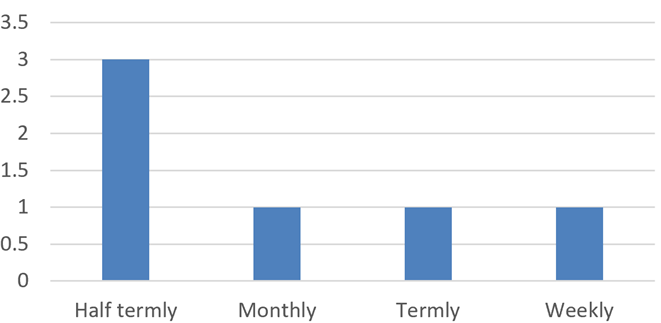
How frequently schools engage in 2-way communication with SEND parents and carers
Two-way engagement regularly took place, ranging from weekly to termly, with half termly being the most popular.
Schools' confidence that their communication is accessible and inclusive
Schools were mostly very confident that communications were accessible and inclusive (for example, translated, jargon-free, available in different formats).

Some barriers to effective communication with SEND families were shared, such as:
- risk of overwhelming parents with high volume of communication, especially when coming from a range of staff members
- some parents also have challenges with SEND themselves which can make communication and engagement tricky
- parents do not always attend support meetings - take up varies with some families having weekly contact and others hard to engage (this can also be dependent on the needs of the child)
- English as an additional language (EAL) brings challenges even with the use of technology to assist with translation
- parents can sometimes feel overwhelmed in the early stages and need more regular meetings to support them with managing their own feelings and worries
When asked what more could be done to deepen engagement with families of children with SEND, there was a range of responses that included:
- multiple strategies have been attempted to engage families of children with SEND with one school planning to host a workshop about the SEND process
- coffee mornings and informal engagement are desired or were noted as a way to invite more feedback but these can be difficult to organise on a large scale - it was suggested that support from the hubs or council would be useful to help do this on a larger scale so that all parents from all schools could benefit
- there is an aspiration to improve co-production of learning plans over the next 2 years
Schools reported a range of approaches to make sure the voice of children and young people with SEND is heard and embedded in planning and review processes. These include:
- surveys and reviews
- development of learning plans
- as part of the Assess, Plan, Do, Review (APDRs) and Individual Education Plans (IEPs), they also have a say in:
- pupil learning studies
- referrals to external organisations
- the Education, Health and Care (EHC) application and annual review processes
- talking to parents and gathering feedback on their child’s experience, alongside using zones of regulation tracking with the child or young person
- asking all pupils with SEND to contribute to their learning pathways and reviews of their targets (all children with our without SEND complete pupil surveys)
- gathering pupil’s strengths and interests and including them in their learning plans - they are also involved in assessing their progress towards their target areas
- regularly involving children in shaping their own support
There were some challenges faced by schools when involving learners with SEND in conversations about their provision. These included:
- managing realistic expectations
- encouraging meaningful engagement
- age impacting successful involvement
- challenges arising if the child is non-verbal or not aware of their diagnosis or needs
- parents not always wanting their child involved
- for some children involvement isn’t always helpful and can create barriers
- staff capacity and lack of resources can hinder involvement
Berkshire Healthcare Trust and NHS Frimley Integrated Care Board (ICB)
The panel received updates from senior leaders from NHS Frimley ICB1 and Berkshire Healthcare Trust, who presented Frimley Health’s strategic priorities.
The presentation highlighted:
- engagement and co-production approaches
- feedback mechanisms
- collaborative work with young people, carers and schools
This provided insight into how statutory services were embedding partnership principles within their improvement programmes.
Strengths observed
Statutory leaders articulated clear strategic priorities and described co‑production within nationally aligned programmes such as the partnership for inclusion of neurodiversity in schools (PINS).
There was evidence of structured governance, including risk logs, commissioning frameworks in development, and a dedicated data and insights workstream.
Rapid cost-control action within the right to choose pathway suggested the system was capable of swift, coordinated responses when required.
There were also positive signs in workforce deployment and community partnership building.
Specialist nursing capacity supported autism and ADHD pathways, and a voluntary sector mapping exercise was used to widen reach and address gaps.
These actions indicated an intent to make support more coherent across sectors.
Gaps identified
Despite progress, families still experienced critical pain points that weakened trust in partnership effectiveness.
Delays in ADHD pathways—particularly medication management undermined confidence in statutory services.
The complexity of system-wide coordination across education, health, social care and the voluntary sector remained a major challenge and risked inconsistent experiences across settings.
Commissioning and access arrangements required further clarity and assurance.
While an indicative activity plan replaced formal caps, price variability across providers and differing access routes (for example, GP only referrals for Right to Choose) risked inequity and confusion.
Data improvement work was underway, but previous inspection findings indicated that analytics and impact evaluation needed to be embedded more systematically to evidence outcomes for children and young people.
What worked less well for families
Families benefited when processes were simple, standards were clear and updates were regular. However, the evidence suggested that these conditions were not yet consistent.
Where eligibility criteria, referral pathways and provider standards were not fully transparent, parents and carers were more likely to perceive barriers, duplication, and uneven quality.
The lack of timely feedback on “you said, we did” outcomes hindered the sense of shared ownership.
Meeting with cabinet member for children and young people
As one of the final parts of the review, the panel met with the cabinet member for children and young people at the time to discuss progress, challenges and emerging themes in SEND services.
The following summary captures the key points raised during the meeting, which informed the panel’s recommendations.
Summary of meeting
The panel heard positive feedback about the first two SEND newsletters, which were praised for their concise and accessible format.
Engagement work continued through the parent carer forum and outreach sessions with pupils, SENCOs and headteachers.
A key theme was the need to strengthen the independence and visibility of the parent carer forum, as awareness among parents remained low.
Pupil engagement sessions were highlighted as particularly valuable for shaping improvements.
The SEND team reported significant improvements in timeliness, with EHCPs and annual reviews now meeting statutory deadlines. However, capacity pressures persisted, with officers managing caseloads of around 250 children.
Measures such as a new telephone system and a duty desk were introduced to improve communication, though managing expectations remained essential.
It was confirmed that in-person drop-ins were not feasible, but duty cover would be available by phone daily.
The discussion addressed parental understanding of the SEND system, noting that while signposting to the Local Offer and advice services continued, some families still struggled with clarity.
Confidence in the system was improving, supported by fewer complaints, more compliments, and better outcomes for children.
Cultural change within the SEND service was evident, with a stable, permanent workforce replacing the previous reliance on agency staff.
Overall, the meeting confirmed progress in service stability and responsiveness but highlighted ongoing challenges in communication, capacity, and parental confidence. This reinforced the need for clearer processes, stronger engagement and improved digital solutions.
Financial considerations
The SEND review report makes recommendations that will utilise and build on existing Bracknell Forest Council solutions, aiming to develop and improve all SEND-related resources within the council.
On this basis, it is understood that the recommendations would be delivered within the overall SEND budget and resources available.
Enhancing co-production arrangements in relation to the SEND strategy will provide a higher probability that the strategy will be effective, improve outcomes and will deliver best value.
Review panel
- Councillor Brown
- Councillor Gaw
- Councillor Penfold
- Councillor Pressland
- Councillor Smith
- Councillor (Chair) Watts
- Councillor Webb
- Councillor Zahuruddin
Contributors to the review
- Cabinet member for Children and Young People at the time - Cllr Roy Bailey
- Executive Director: People - Grainne Siggins
- Assistant Director Education and Learning - Duane Chappell
- Director for Children, Mental Health and Learning Disabilities, NHS Frimley - Tracey Faraday-Drake
- Director of Children, Family and All Age Services, Berkshire Healthcare Trust - Karen Cridland
- Chair of the Parent Carer Forum - Victoria
- Co vice-chair of the Parent Carer Forum: Louise
- Parents and carers from the Parent Carer Forum
- Parents and carers from the Parent Carers Bracknell group
- Parents and carers from Kennel Lane School
- Contributions from headteachers at local schools
- 1
After restructuring, Frimley ICB is now referred to as Thames Valley ICB.