Outcome
Bracknell Forest’s community and professionals have an awareness of domestic abuse and know where to signpost to.
Effective preventative educational programmes, a skilled and resourced workforce, promotion of a culture of prevention and earlier intervention, challenging attitudes and behaviour which foster domestic abuse.
Bracknell Forest’s community and professionals have an awareness of domestic abuse and know where to signpost to.
Create a forward plan of key dates and events in relation to domestic abuse.
A comprehensive calendar of national and international domestic abuse awareness raising days remains in place and is actively used to plan awareness raising activities throughout the year. This enables timely alignment with key campaigns such as 16 Days of Activism, White Ribbon Day, Stalking Awareness Week. ‘Communications’ is a standing agenda item at each Domestic Abuse Forum and Domestic Abuse Executive Group meeting, making sure focus is on public messaging, campaign planning and partner agency coordination. In support of future campaign development, and to take forward recommendations from the 2024 Domestic Abuse Needs Assessment, a meeting with the BFC Communications Team is planned for April 2025 to explore domestic abuse communications for the year ahead, and planning for local and national campaigns, ensuring alignment with local priorities and maximising engagement.
Deliver internal and external communications to challenge negative attitudes and encourage confidence in seeking support and support specific campaigns.
Key communication activity highlights during the year included:
Recommendations from the 2024 Domestic Abuse Needs Assessment relating to public awareness and community engagement will be reviewed in detail with the Bracknell Forest Council (BFC) Communications team and integrated into the development of the new Domestic Abuse Strategy.
The aim is to shape a proactive and inclusive campaign strategy for 2025, with a focus on raising awareness of non-physical forms of domestic abuse, reassuring victims that they will be supported, believed and taken seriously, amplifying survivor voices through positive messaging, promoting service confidentiality, and developing community-specific awareness for underrepresented groups, such as male victims.
Make sure available resources are up to date and distributed, as well as developing new resources as required.
Throughout the year, we continued to strengthen communications and information sharing efforts to improve access to domestic abuse support and services for residents, professionals and partners. This included:
A recommendation from the 2024 Domestic Abuse Needs Assessment included making sure awareness raising materials are available in key languages spoken in Bracknell Forest, to improve accessibility for non-English speakers. This will be reviewed in detail with the BFC Communications team.
Children and young people in the borough are made aware of what constitutes a healthy relationship and domestic abuse.
Improve ways we can work with schools and youth settings to raise awareness of domestic abuse and educate children and young people about safe relationships.
Work is ongoing with Bracknell Forest Public Health to develop a clearer understanding of how local schools can be better supported in adopting a whole school approach.
A survey was issued by public health to all Bracknell Forest schools, asking what topics they would benefit from, including relationship education and related safeguarding themes. Analysis of the responses was completed with a proposal to establish a task and finish group to explore the identified gaps in provision and identify next steps.
The DA Strategic Lead is confirmed as a member of this group which is yet to meet.
A ‘7 minute domestic abuse briefing’ was produced and disseminated to all Designated Safeguarding Leads (DSLs) at their DSL meeting in May 2024 to raise awareness of domestic abuse, support pathways and referral processes.
For further updates on education-based intervention programmes, see below regarding ‘Escape the Trap’.
Professionals working in Bracknell Forest can identify those affected by domestic abuse (including coercive control) and have a strong understanding of appropriate responses and pathways including referrals and interventions.
Deliver multi-agency training available for all professionals working in Bracknell Forest to support early identification and effective responses.
A calendar of training events was delivered throughout the year, offering both face to face and virtual delivery of sessions to maximise accessibility for professionals across Bracknell Forest.
The offer focused on 2 core courses:
Four sessions of each were offered over the year.
Across both courses, a total of 88 professionals were trained.
Training priorities will be reviewed alongside the 2024 Domestic Abuse Needs Assessment which includes:
Carry out an audit to examine agency take up of training in order to challenge where there are gaps and ensure follow up with staff who have attended.
An annual training report for 2023 to 2024 was completed and presented to the Domestic Abuse Executive Group in August 2024 as part of the annual report.
The report provided detailed information on the number of delegates attending both ‘Introduction to Domestic Abuse’, and ‘MARAC and DASH’ sessions, along with a breakdown of agencies attending.
It also included details of other training delivered as one off sessions, and training run by partner agencies.
Following discussion at the August 2024 Domestic Abuse Executive Group meeting, a further agenda item was listed for the November 2024 meeting to review agency engagement in more depth. As an outcome, all Domestic Abuse Executive Group members agreed to review the findings within their organisations and take steps to promote uptake of the training, particularly in underrepresented sectors.
Identify other levels of training and commission where required.
As above.
Schools in Bracknell Forest have timely information about police-attended incidents of domestic abuse; staff in schools understand how to support children experiencing domestic abuse; children receive timely support in their school.
Make sure all schools in Bracknell Forest are aware of and signed up to Operation Encompass.
Operation Encompass is a national initiative that enables police to share information with schools about domestic abuse incidents they have attended where a child or young person is in the family. This allows schools to provide timely and appropriate support to affected pupils.
In 2024 to 2025 the upward trend of Operation Encompass notifications continued with 904 notifications made by Thames Valley Police to schools across Bracknell Forest and Wokingham (data cannot be split). This represents a:
This ongoing rise reflects both improved police identification and sharing of incidents as well as the continued prevalence of domestic abuse affecting families with children.
It highlights the importance of maintaining strong multi-agency coordination and making sure that schools are equipped to respond to pupils with trauma-informed approaches.
The Safeguarding Our Schools Team:
Responsive, effective, joined up support for victims at risk of, or subjected to, domestic abuse and its recurrence.
Victims are safer and have improved resources to remain safe.
Offer an effective target hardening programme which increases safety of victims of domestic abuse in their own home (Sanctuary).
The Bracknell Forest Sanctuary Scheme, launched in March 2022, continues to play a key role in enabling victims of domestic abuse to remain safely in their homes where appropriate, with enhanced security measures, and support for victims.
During 2024 to 2025, a total of 35 referrals were made to the Sanctuary Scheme, a 5% reduction in comparison to the previous year (n=37).
These referrals came from a range of sources including Berkshire Women’s Aid, Bracknell Forest Council Housing, Police, Housing Solutions and Children’s Social Care.
Of the 35 referrals, 27 installations were completed, 8 were cancelled (due to landlord refusal, client moving or withdrawing).
Feedback was actively sought, by the BFC Domestic Abuse Housing Officer, from clients approximately 6 weeks after the installation of Sanctuary Scheme measures. Over the year, 28 clients were contacted, with 15 responding.
Satisfaction with the scheme remains consistently high, demonstrating how the scheme continues to be a valued intervention - helping victims feel safer and supported to stay in their accommodation. Out of the feedback:
100% rated the overall service, support and sense of safety as excellent.
93% rated the information given about the Sanctuary Scheme, standard of work, and contractor professionalism as excellent with 7% rating it as good or not applicable.
93% rated the standard of work as excellent with 7% marked as not applicable (equipment posted due to property restrictions).
Clients were made aware of the scheme through a range of professionals including BFC Domestic Abuse Housing Support Officer, BWA, Children’s Social Care, client’s workplace.
13 of 15 respondents were offered additional domestic abuse support services. Of these, 6 accepted, 4 declined (already receiving support or felt sufficiently supported by friends/family). 3 were already receiving support from BWA Children’s Social Care, or Adult Social Care.
100% remained in their home after Sanctuary measures were installed.
Victims of domestic abuse are offered high quality services which is accessible and meets their needs. This includes support provided in in safe accommodation.
Identify, understand and engage with our diverse/hard to reach communities to raise awareness and provide appropriate support.
Due to limited resourcing, the Thames Valley wide Diverse Communities Partnership Board has not convened since December 2023.
The Berkshire Diverse Communities Working Group met a couple of times over the year, but in October 2024 agreed to merge with the Oxfordshire group, chaired by the Sundial Project (formerly Oxford Against Cutting) and Project Salama.
This newly formed cross-regional group is now known as the Diverse Worlds Group with Sundial providing ongoing leadership.
Sundial began a mini research project in the latter half of 2024 to 2025 reviewing the 2020 Thames Valley BAMER (Black, Asian and Minority Ethnic and Refugee) report recommendations to assess their current relevance. The findings of this research are due to be presented at a meeting in May 2025.
A local Task and Finish group was established to develop a local No Recourse to Public Funds (NRPF) pathway and toolkit, jointly with Hampshire. This group has continued to progress the work which is planned to be completed in 2025 to 2026.
The 2024 Domestic Abuse Needs Assessment identified a recommendation to provide housing assistance for NRPF victims which has helped inform the Safe Accommodation Strategy review.
Provision of an IDVA (Independent Domestic Violence Advocacy) and Outreach service, specifically monitoring the number of referrals to BWA.
Berkshire Women’s Aid (BWA) continues to deliver the commissioned specialist domestic abuse service in Bracknell Forest, providing both Independent Domestic Violence Advisor (IDVA) support for high risk victims and Outreach support for those at standard to medium risk. The table below outlines IDVA and Outreach client data over the last 5 years:
| Client | 2020 to 2021 | 2021 to 2022 | 2022 to 2023 | 2023 to 2024 | 2024 to 2025 |
|---|---|---|---|---|---|
| IDVA clients | 171 | 118 | 109 | 99 | 100 |
| Outreach client | 122 | 120 | 123 | 83 | 111 |
| Total | 293 | 238 | 232 | 182 | 211 |
Overall, the number of survivors referred for support through IDVA and Outreach over the year increased by 16% compared to 2023 to 2024 (n=182).
IDVA support remained stable, halting the previous year on year decline. Outreach support saw a significant increase by 34%, returning to pre-2023 to 2024 levels.
BWA currently work at a safe caseload cap of 25 clients per full time equivalent, with 2.5 FTE workers allocated to Bracknell Forest with a capacity of 62.5 cases.
In addition to the new clients referred to BWA during the year, there were 47 clients carried over from 2023 to 2024 giving a total of 258 active cases in the year and an average active caseload of 55 (88% of capacity), a similar level to 2023 to 24.
An accommodation-based outreach support service for victims of domestic abuse in safe accommodation began in July 2022.
Make sure there is adequate refuge provision for people fleeing domestic abuse.
Over the last year, Berkshire Women’s Aid (BWA) received 480 refuge enquiries (a reduction of 37% compared with the previous year, n=757) and 190 refuge referrals (a reduction of 16% compared with the previous year, n=226).
Of these referrals, 17 individuals were accommodated in Bracknell refuges, with one of these individuals originally from the Bracknell Forest area.
Reasons for not being able to accommodate included (in the main) the client declining the service, unable to establish contact, not meeting criteria, finding another refuge, not being safe in the area.
Work is being done by BWA to monitor the number of refuge voids. While Bracknell refuges historically had little to no voids, this year saw small but consistent voids across most quarters.
A key factor may be the impact of the Domestic Abuse Act 2021, which expanded the definition of ‘priority need’ for housing. This has likely led to more survivors accessing temporary accommodation through local authorities rather than being referred to refuge, although this varies by area.
Bracknell Forest Council offers both refuge and temporary accommodation to survivors fleeing abuse.
BWA also identified a growing preference among survivors for self-contained accommodation, with many declining refuge spaces when informed communal living is the only option. This reflects a changing demand in accommodation type, which BWA is actively exploring.
To maximise occupancy, helpline and refuge staff are working collaboratively to progress suitable referrals.
It is possible that 2024 to 2025 was an anomaly year, influenced by multiple factors, including the cost of living crisis, which may have discouraged some survivors from fleeing due to financial concerns.
The 2024 Domestic Abuse Needs Assessment identified recommendations regarding safe accommodation and housing solutions which are being considered as part of the development of the new Domestic Abuse Strategy.
Provide a therapeutic intervention for recent victims of domestic abuse who have additional mental health needs/complex difficulties (BRAVE – Building Resilience And Valuing Emotions).
BRAVE (for women) and BRAVE Too (for men) continued to offer trauma-informed group support to domestic abuse survivors across Berkshire until the closure of the service in March 2025.
In quarter 1 to 2, 112 individuals from across Berkshire were offered a place (95 women, 17 men). Bracknell Forest accounted for 16 (14%) of these referrals (14 women, 2 men) during this period.
Due to funding uncertainty, referrals for women were paused from August 2024, and overall referral numbers declined. The service was formally closed in March 2025 after long term funding could not be secured.
BRAVE Ambassadors updated the welcome pack for women and the BRAVE Too Ambassadors developed the BRAVE Too Community reunion initiative.
BRAVE supported the DA Strategic Lead in delivery of DA self-harm/suicide risk training in June 2024 for 17 delegates (BF and RBWM), with high demand for further sessions with unfortunately could not be met due to the closure of the service.
BRAVE worked with men and women who had completed the BRAVE programme to develop a film about the impact of reporting to the police which was launched in June 2024. This is planned to be shown to every serving police officer in the Thames Valley.
As part of the Safe Accommodation work, BFC provided a one off grant to Browns Community Services to deliver counselling for up to 20 local clients in 2024 to 2025. This complemented and enhanced existing provision.
Options for future mental health support are being explored by the New Burdens sub-group, following the closure of BRAVE, and aligning with the 2024 Domestic Abuse Needs Assessment recommendations for trauma-informed integrated services.
Deliver interventions to support victims of domestic abuse with children known to Children’s Social Care. (Family Safeguarding Model Domestic Abuse Victim Service - FSM DAVS).
There are 3 dedicated domestic abuse workers in the BFC Family Safeguarding Model (FSM):
As well working with a case load, the victim worker roles include:
Over the last year, the DA Victim Workers received 94 new referrals, an increase of 29% (n=73), compared with 2023 to 2024. Of these, 13 did not proceed due to non-engagement or existing support. On average, 25 cases per quarter were carried over and 90 cases were closed over the year.
The Connected group programme, for any Bracknell Forest resident, continued to offer safe, support peer engagement for survivors with 134 attendances over the year.
There is also continued support through the ‘Together’ mental health group, offering follow on support for adults with mental health needs open to the FSM mental health service.
Survivors were supported with:
Freedom Programme access was enabled for 27 clients through online Freedom codes and 26 clients completed Freedom 1:1 with a worker.
Work with young people was strengthened through healthy relationship sessions with young people open to CSC. Several members of staff are due to attend the Escape the Trap facilitator training.
Delivery of the recommendations outlined in the Bracknell Forest Domestic Abuse Safe Accommodation Strategy (CSP Key Focus Area 3).
The Domestic Abuse ‘New Burdens’ Group has continued to meet regularly throughout the year to oversee the delivery of the Domestic Abuse Safe Accommodation Strategy 2021 to 2024, as required under Part 4 of the Domestic Abuse Act 2021.
The group provides a key mechanism for monitoring progress, identifying gaps and coordinating responses across services. Decisions and recommendations from the group are formally presented to the Domestic Abuse Executive Group via a standing agenda item for ratification and oversight.
In 2024, a full Domestic Abuse Needs Assessment (commissioned) was undertaken to inform future service planning. This included a focus on safe accommodation and housing-related support.
Findings and recommendations from the Domestic Abuse Needs Assessment were used as part of a review against the Domestic Abuse Safe Accommodation Strategy 2021 to 2024 and to inform the next phase of planning.
This review was completed and presented to the Domestic Abuse Executive Group in February 2025 where it was formally endorsed.
The review recognised progress made but also identified specific actions to address gaps in provision and information. The recommendations from this review will feed directly into the new Domestic Abuse Strategy which is currently being developed.
Improved health, wellbeing and resilience for victims of domestic abuse and their children.
Provide accessible specialist support groups for victims of domestic abuse to help break the cycle of domestic abuse (Freedom/Choices/Recovery).
During 2024 to 2025, the Freedom group continued to be delivered consistently, supporting women to recognise and understand patterns of abuse.
Across the year, 4 Freedom groups ran, with a total of 42 women successful completing. Additionally, 27 clients were provided with online access codes, and 26 clients completed the Freedom Programme on a 1:1 basis with a worker, offering greater flexibility to meet individual needs.
The Recovery programme did not run in any quarter due to service capacity constraints.
The Choices group (delivered by Berkshire Women’s Aid) ran in quarter 1 and 2 with 11 sessions delivered, supporting 14 clients. However, the group was paused in quarter 3, due to lack of funding, and no further sessions were delivered during the remainder of the year.
The 2024 Domestic Abuse Needs Assessment identified a need for tailored support for underrepresented and vulnerable groups, including male victims, ethnic minorities, disabled people and older people. Future programme planning will consider these recommendations to make sure service provision is inclusive, accessible and reflective of local needs.
Deliver specialist provision for children and young people affected by domestic abuse (DART, Safe!).
The DART (Domestic Abuse Recovering Together) program helps mothers and children heal from domestic abuse. It ran once in 2024 to 2025, with 10 participants finishing successfully. The programme did not run in later quarters due to school holidays and lack of appropriate referrals.
Safe! which provides specialist support for children and young people affected by crime and abuse, has been unable to provide performance data for 2024 to 2025 due to the introduction of a new case management system.
Safe! shared their latest impact report, published in March 2025, to provide a broader overview of outcomes and developments during the year.
Deliver other appropriate interventions for children and young people affected by domestic abuse.
The ‘Boys Group’ was originally developed to explore:
It was not delivered in 2024 to 2025 due to limited capacity and increased service demand in the Bracknell Forest Youth Justice Team.
However, positive steps have been taken to expand work in this area.
The DAVS worker, the DAPS worker from Children’s Social Care, and a Parenting Worker from the Youth Justice Team will finish training in June 2025. They will then deliver the Escape the Trap program.
‘Escape the Trap’ is a specialist intervention designed to support young people (ages 13 to 25) to:
Though aimed at 13 to 25 year olds, the programme has flexibility to be delivered 1:1 with younger participants (11+) where needed.
Delivery is planned to begin in September 2025 through a combination of school-based sessions, group work at youth hubs, and targeted 1:1 support for young people involved with Early Help and Children’s Social Care.
Victims are engaged with informing improved service provision.
Explore ways to understand the experience of victims of domestic abuse from all social groups to make sure their voices are heard.
Across the year, 60 survivors concluded their BWA support through planned closures, with 56 completing feedback forms.
The feedback consistently highlighted positive impacts on safety, wellbeing, and confidence:
For those with children, support was seen as highly effective:
Survivor voices powerfully illustrated the value of BWA’s support:
“You helped us put everything in place – legal orders, security, emotional support. Before you came on board, I felt despair. What you have done for me is amazing”.
“I felt unstuck. Abuse doesn’t stop, but you helped me through the court crisis and being caught in the system”.
“I would have been a little lost without you. Never used a service like this – totally overwhelmed with happiness and support”.
As part of the Domestic Abuse Needs Assessment, bespoke surveys for victims, survivors and professionals were developed. Insights gathered are helping shape the new DA strategy for 2026 to 2032.
A survey was also completed with victim-survivors to gather their views on the BFC domestic abuse webpages as part of the current review.
In December 2024, the Children’s Social Care DA Victim Workers co-designed and delivered a survivor informed session to CSC and Early Help teams. Based on mixed but honest feedback from the Connected Group, the session focused on improving empathy and understanding in practice. A follow-up bitesize training session was run in February 2025.
Under development since September 2024, in February 2025, BWA launched ‘Voices for Change’, a lived experience group aimed at informing service design, commissioning, and survivor empowerment. The group will be a key contributor to future strategic development.
Reducing the risk to victims by holding perpetrators to account and supporting them to change their behaviour.
Perpetrators of domestic abuse are identified at the earliest opportunity, with interventions implemented and offered to bring individuals to justice or divert their offending.
Referral of perpetrators into appropriate programmes, such as DAPS (Domestic Abuse Perpetrator Service) and Plain Talking (second tier programme). Specifically monitoring the percentage of DAPS clients reoffending who have completed the agreed work (CSP Key Focus Area 3)
This year, the DAPS (Domestic Abuse Perpetrator Service) received 76 new referrals, representing a 21% increase when compared with 2023 to 2024 (n=63).
Of these, 47 (62%) engaged or were on the waiting list. 29 (38%) did not pass the assessment. This was due to non-engagement or unsuitability. Examples include not accepting responsibility, having support elsewhere, or other complex needs.
The DAPS worker managed an average caseload of 14 open cases per quarter, with a waiting list ranging between 3 to 9 individuals.
At the end of quarter 4, 134 had meaningfully engaged with the programme over the previous 4 years. 86 have completed the structured 1:1 intervention (typically 16 sessions). 10 have reoffended, giving an overall re-offending rate of 11.6%.
Plain Talking (Behaviour Change Programme) is a 1:1 therapeutic intervention for men and women:
Run by a member of staff from the Community Safety Team, Plain Talking remains a key tool in early intervention, engaging lower-risk individuals in a structured, monitored behaviour change, with a strong emphasis on voluntary participation.
Across the year, 13 new referrals to Plain Talking were received with 8 being accepted onto the programme.
Quarterly open cases ranged from 10 to 12, including those in active work and “keep in view” maintenance. Across all quarters, no further DA offending was recorded for cases being actively managed.
Referrals were consistently received from a range of sources including Children’s Social Care, MATAC, Early Help and self-referrals.
Keep informed of, and contribute to, the work of the Domestic Abuse Perpetrator Programmes Thames Valley Network.
TVP are waiting to see what perpetrator programmes can be offered before launching any network.
DRIVE is a high risk, high harm domestic abuse perpetrator intervention service that works to disrupt, intervene, engage and support perpetrators of domestic abuse. It aims to remove triggers, reduce risk and increase long term safety measures for present and future victims, survivors and children.
In early 2023, the OPCC, in conjunction with TVP, were successful in a bid to the Home Office Perpetrator Fund to roll out DRIVE across TV.
244 referrals have been received Thames Valley wide by DRIVE since February 2024.
9 (4%) of these referrals have been from the Bracknell Forest area with 4 (44%) accepted to DRIVE case management. 3 remain open and 1 has since been closed.
Referrals were paused in late 2024 to allow for a review and reflection of the first 12 months.
Following this review, and further funding secured to March 2026, DRIVE restarted referrals in March 2025 with DA perpetrator panels due to restart in April 2025. Referral pathways have been expanded to include police referrals, in addition to MARAC and MATAC.
Weekly progression meetings are also now held to fast-track appropriate cases or remove ineligible ones.
Other perpetrator initiatives running across the Thames Valley include:
Project PIPA, delivered by RISE Mutual, started a trial across Thames Valley for 6 months from January 2025.
The conditional caution is available with diversion to a perpetrator programme as one of the conditions.
This is available for standard risk cases of DA and only where certain criteria are met to be eligible for an out of court disposal. It can be used for medium risk cases with the authority of the CPS.
The ethos of this option is to address the perpetrators offending behaviour, make sure of swift resolution for victims and survivors, and reduce future harm.
COBI provides intensive intervention with perpetrators of high-risk stalking, for the purpose of reducing stalking and reoffending across the Thames Valley.
A series of 1:1 facilitated sessions address stalking behaviours, including any emotional responses and triggers.
It targets the causes of stalking behaviour addressing issues such as obsessive thoughts.
Referrals can arise as a requirement of a Stalking Protection Order, police conditional caution, license conditions or Rehabilitation Activity Requirement (RAR) from Probation.
Monitor the reduction of harm through the work of the MATAC (CSP Key Focus Area 3).
The MATAC (Multi Agency Tasking & Coordination) process of identifying and tackling serial perpetrators of domestic abuse is well established across the Thames Valley.
The Bracknell Forest MATAC has good success rates of engagement with perpetrators through partner agency contribution.
Previous perpetrators have been removed from the process due to a reduction in demand and new cohorts have been enrolled. Perpetrators who have not engaged with the process have been placed on to the ‘catch and convict’ scheme which makes sure local officers deal with all criminal offending robustly and expeditiously.
The maximum number of perpetrators on MATAC at any one time is 4 to 5 and referrals from all agencies will be considered.
The MATAC Coordinator will also use the RFGS Matrix (Recency, Frequency, Gravity, Serial (number of victims) to help identify serial DA offenders who can cause long term harm.
All MATAC police work is due to be carried out by the East Berkshire LCU Harm Reduction Unit following the police restructure, due to go live in quarter 1 2025 to 2026.
There is a clear pathway of options for the panel (attendance is the same as at MARAC) with the aim to reduce offending and prevent harm to current and future victims.
Current DVPOs are discussed at the end of MATAC meetings for any quick time support that can be put into place for the victims and perpetrators.
Over the year, there were 9 new referrals to MATAC (remaining relatively steady across all quarters) with 5 cases closed. At the end of March 2025, 6 cases were open. Reoffending continues to be tracked post closure with some evidence of further incidents.
It should be recognised however that MATAC is a qualitative process that cannot always be measured in numbers. The work that is undertaken by the successful collaboration of police and partners can benefit and support both perpetrators and their families in any numbers of ways, both short term and long term. However, it is often unseen and undetected in data.
Engage early with perpetrators of adolescent to parent abuse (Who’s In Charge).
Throughout the year, 7 Who’s In Charge (WIC) programmes were delivered to support parents and carers experiencing child and adolescent to parent violence and abuse (CAPVA). The sessions included both day and evening groups to increase accessibility.
A total of 70 referrals were received across the year, with several referrals involving multiple parent and carer participants.
A Domestic Abuse Victims Worker (Children’s Social Care) is now trained to deliver Who’s In Charge and will be co-delivering the programme with the Youth Justice Service from April 2025 to strengthen delivery capacity.
The Building Respectful Families (BRF) service, delivered by Safe! provides support for families affected by Child and Adolescent to Parent Violence and Abuse (CAPVA) where young people are aged 8 to 18 years old. It offers information, advice, training and support to families and professionals including one-to-one sessions and restorative dialogue.
Over the year, 4 referrals from Bracknell were received. 3 families were provided with support with outcomes post support of a reduction in physical violence, improved parent child relationships, increase parental confidence and understanding and support towards ADHD assessment and diagnosis.
One referral was deemed inappropriate due to high needs, so the family were signposted to other support services.
Increased safety of victims and children.
Make best use of powers available to protect victims of domestic abuse and manage and disrupt perpetrators:
A DVPN is an emergency notice issued by police following a domestic abuse incident, imposing immediate, short-term conditions on the perpetrator, for example prohibiting contact with the victim or returning to the address, for up to 48 hours.
A DVPO, granted by a magistrates’ court within the 48 hour period, can extend these conditions for up to 28 days, providing the victim with space to consider options and engage with support services.
These are civil, preventive measures where criminal charges are not yet possible but immediate protection is required.
There has been a year-on-year increase in the use of DVPN/Os with:
Under the Domestic Abuse Act 2021, DAPOs and accompanying Notices (DAPNs) will replace DVPN/Os in due course.
Key features include:
These provisions are being piloted by Greater Manchester, Croydon, Sutton, Bromley, Cleveland, North Wales and British Transport Police.
TVP continue to manage increasing demand for both the ‘Right to Ask’ and the ‘Right to Know’ elements of the scheme.
A total of 139 applications were processed in 2024 to 2025 across Bracknell Forest. Compared to 2023 to 2024, this represents a 39% increase in the volume of applications (n=100).
‘Right to Ask’ (public initiated) applications rose by 52%, indicating increased public awareness or confidence in the process; the disclosure rate doubled, suggesting improved decision-making, risk identification or relevance of applications.
There was a slight drop in the number of ‘Right to Know’ (police initiated disclosures based on intelligence or concerns) applications. But the disclosure rate increased from 26% to 36% possibly reflecting focused risk-led policing.
Actions this year reflect key recommendations from the 2024 Domestic Abuse Needs Assessment including:
Recognising the adverse impact of domestic abuse and the need to promote change through joint commitment, leadership and partnership working.
Victims receive responsive services and co-ordinated service pathways, which support sustained recovery and a reduction of risk of further harm.
Clarify and publish clear referral pathways for agencies when they receive a disclosure of domestic abuse.
The Bracknell Forest Domestic Abuse pathway remains a key tool to support effective responses to domestic abuse. The pathway was most recently updated in March 2025 and continues to be routinely shared with professionals attending domestic abuse training sessions to support consistent practice and referrals across services and is published on the BFC domestic abuse webpages.
A specific pathway for individuals with No Recourse to Public Funds (NRPF) is underway, in collaboration with Hampshire.
In November 2024, a quality assurance visit was conducted by the DA Strategic Lead as part of a ‘secret shopper’ exercise to assess the response of Safe Spaces venues in Bracknell town centre (the Lexicon).
This exercise aimed to test staff awareness, responsiveness and the practical implications of the Safe Spaces initiative, which is coordinated nationally by Hestia.
Two participating venues were visited anonymously. At one, the response was positive with staff demonstrating appropriate awareness of the initiative and a clear understanding of how to support someone seeking help.
At the second venue, the response was inadequate, raising concerns about staff preparedness and the potential risk of inappropriate or unsafe handling of a disclosure.
Detailed feedback was provided to Hestia for action including staff training and undertaking assurance measures to avoid recurrence.
Improved coordination of high-risk domestic abuse cases including better information sharing, repeat victimisation and improved agency accountability.
Provide strategic oversight to the MARAC to make sure that it is working to good practice levels with a focus on increasing referrals from a range of agencies.
A total of 110 referrals were made to the Bracknell Forest MARAC during 2024 to 2025.
Referrals were made by a range of agencies throughout the year.
Key referral sources included:
As a direct outcome of a SafeLives MARAC review of the Thames Valley MARACs in 2023, the East Berkshire MARAC Quality Assurance Group was established.
This cross-authority group reports directly into the Domestic Abuse Executive Group. It brings together the following representatives to oversee and improve MARAC performance across East Berkshire:
The group meets quarterly to review data, examine case examples, address training needs, and support consistency in practice.
It also provides a space for shared learning and system-wide improvements aligned to the recommendations of the SafeLives review.
A full East Berkshire MARAC report is due to be presented to the Bracknell DA Exec Group in August 2025.
Monitor the number of repeat incidents including MARAC repeat rate.
The MARAC repeat rates in Bracknell Forest remained broadly stable throughout 2024 to 2025, being 25% in quarter 4.
This figure remains slightly below the SafeLives’ expected benchmark of 28% to 40% but suggests consistent identification and management of repeat cases.
The Thames Valley Police (TVP) repeat victimisation rate for Bracknell Forest showed a downward trend across the year, having increased from 42.0% in 2022 to 2023 to 43.7% in 2023 to 2024 before falling to 42.4% in 2024 to 2025.
While quarter 1 saw Bracknell Forest holding the joint second-highest repeat rate in the force, the rate steadily declined over the year.
By quarter 4, Bracknell Forest had one of the lowest rates in the force and was below the TVP average.
Improved agency responses to domestic abuse following a domestic abuse related death.
Undertake Domestic Abuse Related Death Review (DARDR) where the criteria has been met.
Following the death by suicide of a Bracknell Forest resident in June 2022, the Community Safety Partnership (CSP) agreed to commission a Domestic Abuse-Related Death Review (DARDR).
An independent chair and author was appointed in February 2023 with review panel meetings taking place between March 2023 and February 2024.
The final overview report and action plan were approved by the CSP at the beginning of May 2024 and submitted to the Home Office Quality Assurance (QA) Panel for review.
Make sure the learning from DARDRs and Serious Case Reviews (SCRs) are proactively shared with partners including the MARAC, Domestic Abuse Executive Group, Domestic Abuse Forum, Bracknell Forest Safeguarding Board and commissioners of services, and included into local and regional training programmes.
Feedback from the QA Panel was received at the end of November 2024, noting the report was strong and sensitively written, with some minor points for further development.
These were addressed by the chair and author. The report and accompanying learning brief were finalised and published (Jenny) in February 2025 following contact with the family.
The report has been shared with the Bracknell Forest DA Forum and DA Executive Group, the Berkshire Suicide Prevention Group, the Office of the Police and Crime Commissioner for Thames Valley, the DA Commissioners Office, and the Home Office.
A formal presentation is scheduled for the Berkshire Suicide Prevention Group in May 2025.
Adult Q SAR and learning brief was published with learning events taking place over the summer and autumn 2024.
Monitor and audit the actions against recommendations and intended outcomes to make sure changes are implemented by partner agencies.
The ‘Jenny’ DARDR action plan was submitted to the Home Office in May 2024 and is being kept as a live document.
It is reviewed and updated on a quarterly basis, shared at each DA Executive Group to make sure of progress and accountability across partner agencies.
Improved information sharing to support our understanding about the picture of domestic abuse in Bracknell Forest.
Collate and review accurate and consistent performance of both specialist and statutory services through an agreed data set.
An agreed multi-agency domestic abuse data set is in place and reviewed quarterly at the Bracknell Forest DA Executive Group.
Data contributions are provided by Thames Valley Police, MARAC, BFC Housing, BFC Family Safeguarding Model (victim and perpetrator services), Berkshire Women’s Aid (BWA) and BFC Children’s Social Care.
During the year, the BWA submission was enhanced to include summary demographic information and a case study. The full BWA annual report is also shared annually with the DA Executive Group to support oversight and planning.
The BFC 2024 Domestic Abuse Needs Assessment highlighted the importance of robust, consistent data collection and multi-agency collaboration. Key recommendations will inform ongoing development of the DA data set and wider performance framework.
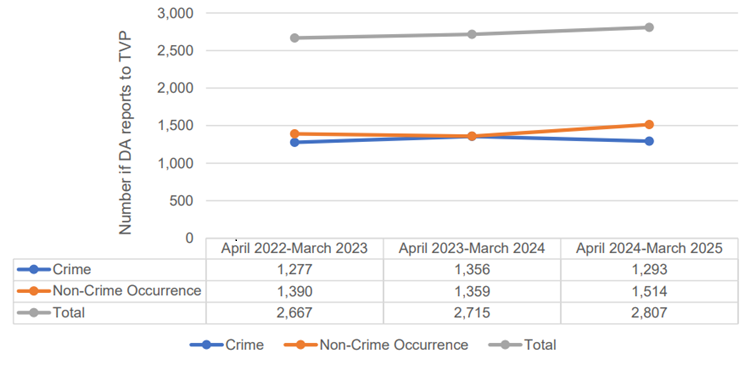
The below graph shows the number of domestic abuse occurrences in Bracknell Forest recorded by Thames Valley Police over the last 3 years which have steadily increased by 5%.
While the number of crime occurrences peaked in 2023 to 2024, they declined again in 2024 to 2025, stabilising close to 2022 to 2023 levels.
In contrast, non-crime occurrences fell slightly in 2023 to 2024 but there was a notable rise in 2024 to 2025.
Domestic abuse crime and non crime occurrences in Bracknell Forest (Thames Valley Police)
Carry out a full domestic abuse needs assessment every 3 years with an annual refresh to define and monitor domestic abuse at a local level.
In May 2024, Davis and Associates were successfully commissioned to undertake the Bracknell Forest Domestic Abuse Needs Assessment.
The final assessment was submitted in October 2024 following presentation of a draft to the Domestic Abuse Executive Group in August and subsequent accuracy checks.
The Domestic Abuse Needs Assessment provided key insights into local prevalence, service provision and system gaps.
Its findings helped inform the review of the Domestic Abuse Safe Accommodation Strategy 2021 to 2024 and are helping shape development of the new Bracknell Forest Domestic Abuse Strategy and Work Plan 2026 to 2032.