To reduce emissions and achieve net zero through energy efficiency, electrification and substitution.
In July 2025 Bracknell Forest Community Climate Action (BFCCA) hosted the third Bracknell Forest Community Climate Summit with support from Bracknell Forest Council. To maximise participation, the summit was held on 2 dates at 2 different locations:
- Wednesday 16 July at Kerith Community Church in Bracknell
- Friday 18 July at Wellington College in Crowthorne
The summit brought together nearly 200 local residents and representatives of local businesses, charities, community groups, schools, as well as councillors and council staff. Inspiring speakers, engaging workshops, marketplace stalls and collaborative discussions explored how we can tackle climate change in our community.
Building upon the Community Climate Emergency Strategy vision developed at the 2024 summit, this year’s summit was an opportunity for the Bracknell Forest community to shape a first draft of the strategy. It also provided opportunities for attendees to learn more about climate change, key challenges and how they can be part of the transition to a net-zero future.
Keynote speakers included:
- Professor Ian Candy from Royal Holloway University of London on understanding the climate crisis and its impacts
- Russell Julier from BFCCA on the development of the Community Climate Emergency Strategy
Understanding the climate crisis and its impact
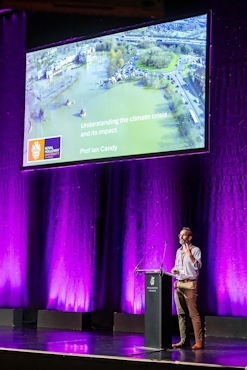
Professor Ian Candy provided an overview of the climate crisis and the science behind it. Drawing from the work of the Intergovernmental Panel on Climate Change (IPCC), Professor Candy discussed the direct relevance and implications of climate change within the UK. He explored, for example, how warmer temperatures, drought and increased wildfire risk could affect the types of trees we plant, the biodiversity of our landscapes, and the way we will manage woodland areas.
For those new to climate science, he recommended the Royal Society (UK) and US National Academy of Sciences publication Climate Change: Evidence and Causes, which answers 20 of the most frequently asked questions on climate change. He also highlighted research from Royal Holloway, UNICEF (United Nations Children's Fund), and LSE (London School of Economics) on how behavioural science and storytelling can help bring about meaningful change.
Throughout his talk, Professor Candy encouraged attendees to seek out reliable, science-based resources to deepen their understanding of climate change and its consequences. As he explained, climate science is essential to informed decision-making, and local action must be rooted in the best available evidence.
BFCCA and Community Climate Emergency Strategy
Russell Julier, BFCCA Trustee, presented a first draft of the organisation’s Community Climate Emergency Strategy to attendees. With the aim of enabling the community to reduce emissions, protect the environment and increase community resilience, BFCCA engaged attendees to capture ideas, activities, and local best practices to enable others to act.
The council’s own Climate Change Strategy aims to support the reduction of net borough emissions to zero as close to 2030 as possible, and engage and empower residents and communities to take climate action. BFCCA’s Community Climate Emergency Strategy complements this, by focusing on the actions that individuals and the wider community organising together can take to tackle climate change.


The draft BFCCA strategy had 5 aims:
1: Reduce emissions
2: Support biodiversity
To address the biodiversity crisis by protecting and enhancing our natural environment.
3: Create a sustainable environment
To create a sustainable environment, community and economy through green choices in our personal and community lives.
4: Enhance community resilience
To help our community adapt to the changes ahead by enhancing our natural, physical, mental, energy and economic resilience.
5: Share knowledge
To share our community knowledge of what we have done, what works, and what we could do better, so that others may learn and do.
The development of this strategy is intended to inspire individuals to take action and reduce emissions by sharing the real-life experiences of local people, businesses, and organisations that have made changes, giving others the confidence to act and help themselves.
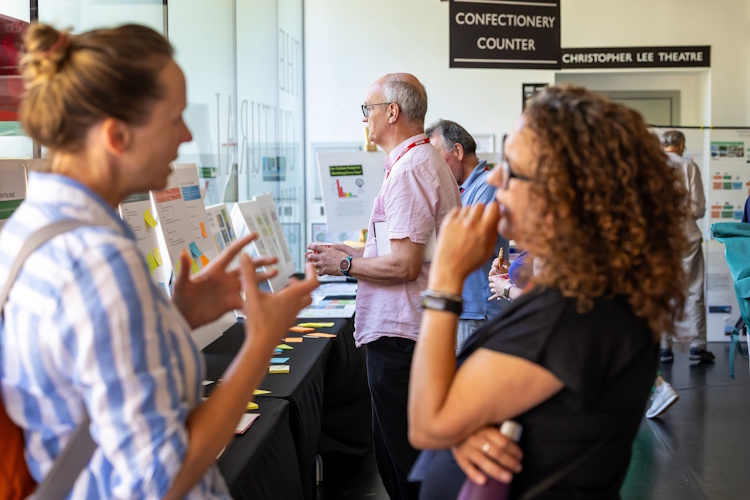
BFCCA sought the input of local residents and stakeholders on how the aims could be achieved. Attendees shared valuable feedback, ideas and local insights during the question and answer session of the keynote. The event also featured BFCCA's own stand, where attendees were invited to contribute their suggestions in more detail.
All the feedback gathered from the question and answer session, informal conversations and written contributions will directly inform the final version of BFCCA’s Community Climate Emergency Strategy.
Workshops
Summit attendees participated in workshop sessions aligned with the main themes of BFCCA’s Community Climate Emergency Strategy.
These themes were:
- Buildings and energy.
- Transport.
- The natural environment.
- Greening the economy.
- Health, wellbeing and food.
These workshops were facilitated by experts and specialists in these fields, and were an opportunity for attendees to develop their knowledge and identify practical actions that can be taken to tackle climate change in the local community.


1: All about Electric Vehicles (EVs): Common myths and misconceptions
Facilitated by Mark Smith of the Energy Saving Trust. This workshop explored the Transport theme, and focused on tackling incorrect perceptions surrounding electric car ownership.
2: Building our net zero electricity system
Facilitated by Haulwen Goldie-Jones of Scottish and Southern Electricity Networks. This workshop explored the Buildings and Energy theme, specifically the ability of communities to impact new grid infrastructure.
3: How nature fires up our brain
Facilitated by Dr. William Bird of Intelligent Health, and Cllr. Megan Wright of Bracknell Forest Council. This workshop focused on the Health, Wellbeing and Food theme, exploring the importance of nature to our own health and happiness.
4: Understanding the climate crisis and its impacts
Facilitated by Professor Ian Candy of Royal Holloway, University of London. The workshop provided an introduction to climate change and why it matters.
5: The impact of climate change on UK wildlife
Facilitated by Joe Malyan of Bracknell Forest Council. This workshop focused on the Natural Environment theme, examining the ways in which UK wildlife is already under threat by climate change and what the future of our biodiversity may look like.
6: Energy, insight, action: A community sustainability journey
Facilitated by Calum Field of Kerith Community Church, and George Douglas of Douglas Energy Solutions. This workshop explored the theme of Greening the Economy, and investigated the steps Kerith Community Church have undertaken to improve their sustainability.
7: Sustainability at Wellington College
Facilitated by Ana Romero and Edwin Wai of Wellington College. This workshop explored the theme of Greening the Economy, and detailed the innovative and sustainability projects Wellington College is undertaking, including land management and the installation of heat pumps.
Marketplace stalls
During the summit, attendees also had the opportunity to visit a range of marketplace stalls showcasing climate and sustainability initiatives and the work of BFCCA, community groups, businesses and council teams. These included:
- Abri
- BFCCA
- Bracknell Forest Council Transport Team
- Bracknell Forest Council Waste and Recycling Team
- Climate Ambassadors Scheme
- Connected Communities
- Douglas Energy Solutions
- Easthampstead Park Hotel
- Eco Rewards
- Energy Saving Trust
- Heat Collector
- Involve
- Jealott's Hill Landshare
- Peter Swallow MP
- Royal Berkshire Fire and Rescue Service
- Solar Together


Attendance and feedback
Over 240 people registered for this year’s event, with 199 individuals attending.
There was representation from a broad range of sectors and 48 different local organisations. In comparison to the 2024 summit, this year’s event engaged 150 new attendees.
Feedback was collected from attendees. A large majority of attendees scored highly when asked how much they enjoyed the event, and 87% of respondents said that they would definitely attend another summit in the future.
The following feedback has been scored from 1 to 5. 1 is "not at all" and 5 is "very much".
Overall enjoyment
How much did you enjoy the event overall?

Keynote speech and workshops
Attendees provided feedback highlighting how engaging and useful they found aspects of the event. A large majority of attendees scored highly when asked how useful and engaging they found both the keynote speeches and the workshops.
How useful and engaging did you find the keynote speech on climate change and BFCCA's community climate strategy?

How useful and engaging did you find the workshop?

Opportunity for attendees to contribute
A key focus of the event was to explore and discuss the opinions residents had of BFCCA's Community Climate Emergency Strategy.
Each workshop focused on a different aspect of the strategy, where attendees had the opportunity to raise any questions and provide feedback on how the strategy could be achieved. Following the event, respondents were asked whether they felt they were able to contribute to BFCCA's strategy.
Respondents broadly found the event was a good opportunity to contribute to the strategy, with over 70% giving a rating of 4 or more.
How good an opportunity did you feel the summit gave you to contribute to BFCCA's community climate strategy?

Summit benefits to attendees
Attendees were also asked what benefits they felt they gained from attending the climate summit.
Respondents primarily gained useful contacts and leads, felt they gained more enthusiasm for climate action, and gained a better understanding as to how to shape community climate action.
Which of the following did you get from the summit?

Attendees were asked whether, as a result of the event, they had been inspired to commit to any new actions.
The responses reveal 2 dominant themes:

Making individual lifestyle changes

Community-based environmental engagement
Many participants highlighted their commitment to tangible personal actions such as increasing active travel, reducing energy use, recycling more effectively, and considering or investing in technologies like electric vehicles, solar panels and heat pumps. These changes reflect a growing awareness of how day-to-day behaviours impact the environment and a willingness to act. Some are also seeking to deepen their understanding of climate issues and explore sustainable living practices at home.
Alongside personal changes, there was clear enthusiasm for community involvement and collaboration. Participants expressed interest in volunteering with local environmental groups, supporting nature initiatives, and encouraging neighbours and colleagues to get involved. Several responses also highlighted plans to connect with others met at the summit, build partnerships, and share ideas more widely. Following the summit, residents were inspired to contribute to climate action both individually and collectively.