
This consultation is now closed.
You can read an easy read version of this page.
Have your say
Each year the council must set a balanced budget. This sets out where we plan to spend and save money - including the council tax residents pay us.
Our budget is split into 2 parts - revenue budget and capital budget. The revenue budget pays for day-to-day things like social care, bin collections and street lighting. The capital budget pays for things like new buildings and roads or maintaining existing ones.
In 2026 to 2027 we plan to spend:
- £136.5 million in the revenue budget
- £12.3 million in the capital budget
We want to hear your views on our draft budget for 2026 to 2027.
Before you take part in our consultation, you might like to read the rest of the information on this page. We explain, in more detail, the difference between the revenue and capital budget and how we plan to use the draft budget.
Have your say on our 2026 to 2027 draft budget
The public consultation runs from 17 December until 27 January.
Drop in sessions
You can also give us feedback at one of our drop in sessions on:
- Friday 19 December, 11am to 3pm at The Lexicon community cart (Braccan Walk South)
- Wednesday 7 January, 10am to midday at Crowthorne Library
- Friday 9 January, 10am to midday at Tesco Warfield
- Thursday 15 January, 6pm to 8pm at Bracknell Leisure Centre
Budget gap
A budget gap means the difference between the money we expect to spend and the money we expect to receive.
We have an estimated budget gap of £10.1 million in 2026 to 2027 due to:
- increasing demand for services like special educational needs and disabilities (SEND) and social care
- rising costs and inflation
- years of central government underfunding
- a review of the money we get from central government (Fairer Funding Review 2.0), meaning our grant funding will not rise by the level we need it to
This means we are having to stop or reduce some non-statutory services, reduce staff costs, renegotiate contracts and look at how we do things differently in future. We also need to use some of our reserves to make sure the budget balances.
The draft budget papers set out detailed spending and saving proposals for 2026 to 2027 for both the revenue and capital budgets. They also detail spending and saving themes for the 2027 to 2028 and 2028 to 2029 budgets.
Council budget explained
This video explains more about our budget. This content is also covered in the information on the rest of this page.
Revenue budget
The revenue budget covers day-to-day spending, including:
- running local services like social care, waste collection, housing and homelessness support, community safety, libraries and leisure services, parks and countryside, public health, school admissions, pothole repairs and street lighting
- grants to community groups, charities and partner organisations (for example, South Hill Park, Involve and Citizens Advice)
- debt and interest repayment on any loans or borrowing
It also pays for staff costs, office costs and utility bills.
Plans to stop or cut in the revenue budget 2026 to 2027
Subject to the necessary impact assessments, some of the bigger proposals include:
- saving £248,000 by stopping the 299, 598 and 151/151A bus services - these services cost a lot to run and are poorly used in terms of the number of passengers (some single trips cost the council more than £16 each)
- saving £380,000 by rescheduling the kerbside glass collection scheme so it starts in March 2027 instead of autumn 2026
- looking to fund climate change projects through other ways like grants and commercial investment - this will save around £50,000 in 2026 to 2027
- saving £275,000 by reviewing the Better Care Fund Grant with partners in the NHS to prioritise intermediate care and reablement services
There are many smaller savings planned like stopping professional subscriptions, revising contracts, and reducing budgets for cleaning.
There are also savings identified through staff restructures and streamlining - most of the savings will come through removing vacant posts when staff leave or retire rather than through redundancies.
Capital budget
Capital spending is focused on projects that create or improve ‘assets’.
This could be buildings or other assets like roads, bridges or pavements. It is usually paid for by government grants, borrowing, capital receipts (from asset sales), and the money developers pay us.
Plans to spend capital budget in 2026 to 2027
The draft capital budget shows that we will spend money on council buildings and some school buildings.
Some of the other proposed spending for 2026 to 2027 includes:
- continuing the planned investment of £2.7 million to upgrade and maintain highways (including roads, pavements, drainage, bridges and cycle lanes)
- a possible £95,000 investment in play area upgrades
- investing more than £650,000 in local leisure facilities, including the running track at Bracknell Leisure Centre and essential maintenance at Coral Reef Waterworld and Downshire Golf Course
- a £50,000 investment in Bracknell Day Services to create extra space and support for adults with learning disabilities
How the council gets its money
The council’s budget is made up of:
- money from central government (sometimes referred to as grant funding)
- Council Tax
- business rates
- money that developers pay us
- income from fees, charges and sponsorship
- borrowing and loans
Savings (reserves)
We have money saved for unexpected and unforeseen emergencies. It is often referred to as ‘reserves’. We can also use this money to bridge any budget gap.
Currently, £23 million of our reserves are already allocated to plugging the hole in SEND funding.
In addition, we have £10 million in reserves that could be used to support the budget. We expect to have to use a substantial proportion of our reserves to balance the 2026 to 2027 budget.
The council is not bankrupt, but must continue to manage its money prudently and sensibly. This will be challenging over the longer term. We’ve been financially well managed for many years, rising and responding to funding challenges. However, we are facing an increasingly difficult financial position and are having to make tough decisions to balance the budget as well as using up some of our reserves.
How we spend Council Tax
Council Tax pays for spending in the revenue budget, which is the day-to-day costs of providing services. You can read more about how your money is spent 2025 to 2026.
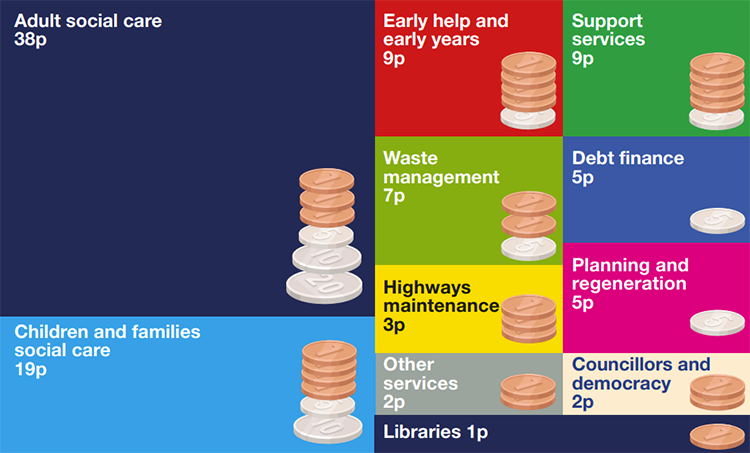
The infographic and table below shows how we spent every pound of council tax in 2025 to 2026, which will be very similar in 2026 to 2027.
How your £1 is spent
| Council service | Spent in every pound |
|---|---|
| Adult social care | 38 pence |
| Children and families social care | 19 pence |
| Early help and early years | 9 pence |
| Support services | 9 pence |
| Waste management | 7 pence |
| Debt finance | 5 pence |
| Highways maintenance | 3 pence |
| Planning and regeneration | 5 pence |
| Other services | 2 pence |
| Councillors and democracy | 2 pence |
| Libraries | 1 pence |
Highways maintenance
Spending on highways maintenance covers day-to-day spending on things like potholes and other repairs. It does not cover major projects like new roads, road resurfacing projects or new pedestrian crossings. Instead, these are paid for through the capital budget, which includes our annual government funding for highway maintenance.
Council tax for 2026 to 2027
The draft budget plans do not detail the proposed level of council tax for 2026 to 2027. However, given that central government assumes a council tax increase when working out how much grant to give us, and our large budget gap, an increase is likely.
Any rise and the level of increase in council tax will be a matter for councillors in February 2026.
Our residents
We've put together some examples of the types of residents we have living in Bracknell Forest.
Peter, 72 - retired

At 72, I’m enjoying new ways to stay connected with my family. Thanks to the council’s free tech support sessions, I’ve learnt how to videocall my grandson. I also go along and watch my grandson play for his junior football team on Saturday mornings at Farley Wood. These pitches are looked after by the council with free parking and facilities on site.
Swimming has always been my favourite way to stay active. I enjoy the senior sessions at Bracknell Leisure Centre, which make it easy and fun to keep moving. I like living in an area that’s got lots of sporting and leisure facilities - it helps me to keep fit, healthy and connected.
Taylor, 19 - carer
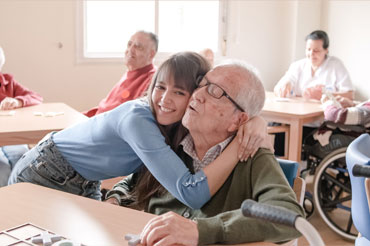
My grandad, who brought me up, was diagnosed with dementia last year and has severe arthritis, so I spend lots of time caring for him.
The adult social care team helped us by installing a sensor-linked alarm at home. I’m grateful for Forestcare’s 24/7 telecare service, which monitors the alarm while I work night shifts. I’m also speaking to the council’s community mental health team about what support might be available for both me and my grandad, including short breaks and emotional and financial help.
Throughout the week, we attend dementia groups that are supported by the council. My grandad loves the knit and natter sessions and I appreciate the carers’ meetups. It makes such a difference having a community that understands my situation.
Martinez family
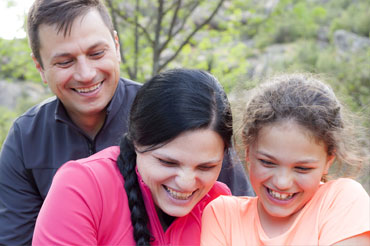
Our family moved to Bracknell Forest from London a few years ago. We needed help from the school admissions team to change our daughter Tia's primary school. Nearly 3 years later, she’s now moving into Year 7! The council’s online school admissions system made applying for secondary schools simple, and their ‘guide to secondary education’ was a big help.
We moved from London to be closer to green space, but we didn’t want to give up being close to amenities. We’re so spoilt for trees and greenery compared to where we used to live but also have great shops and restaurants on our doorstep. We’re also pleased Tia can safely see her friends after school and can take part in lots of other activities like swimming and gymnastics.
Sofia, 35 - part-time teaching assistant
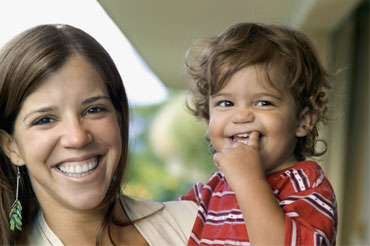
2025 has been a whirlwind of a year for my family. In March, I was made redundant, which was tough - I had no idea how to find a new job. Fortunately, my friend told me about a job club run by the council at the Open Learning Centre. They helped me improve my CV and interview technique. Thanks to their support, I got a part-time job as a teaching assistant. I love my job and have since enrolled on the council’s ‘working in schools’ course to improve my skills.
I needed some childcare for my little boy, Ethan, while I was at work. I used the council’s family information service to work out what childcare funding I was entitled to and find a pre-school, which Ethan loves! Ethan has special educational needs, so I also use the council’s additional needs info hub for information and advice.
Minah, 23 - trainee doctor

I’m studying to be an NHS doctor. Every day, I walk to Bracknell station and take the train to my placement at the Royal Berkshire Hospital. I’m glad the council keeps the streets clean and makes sure that the underpasses are brightly lit - it makes my walk more pleasant, especially at night.
My mum recently moved to Bracknell, and I’ve been showing her around. She particularly likes The Lexicon, Bracknell Library, the Open Learning Centre, and The Look Out. As English is her second language, she attends the ESOL programme (English for speakers of other languages) run by the adult and community learning service. These classes have boosted her confidence to the point that she now needs far less support from translators. She’s also attended some of the World Café events at the council’s Time Square office - this is all helping her become part of the local community, find friends and find work.
Adrian, 41 - delivery driver
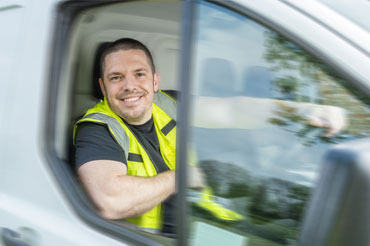
I’ve lived in Bracknell Forest all my life - Sandhurst born and raised. I work as a delivery driver, so it’s good to see the council is spending money on maintaining roads. About 9 months ago, I was on a delivery route when I saw some blocked drains. I immediately reported the incident through the council’s website, which was easy to use.
My partner and I are currently having a single-storey extension built. We got planning permission but didn’t know we needed building regulation approval too. The council’s building control team made the process simple. They came out promptly and made sure everything was safe.
Alex, 20 - full time student living with housemates

As a full-time student I don’t have to pay council tax, which is one less bill to worry about while I study. I live in a shared house with 5 other people, so technically house of multiple occupation (HMO). As I live in an HMO, the council’s licensing team makes sure my home is safe and adequately managed by my landlord. This gives me peace of mind. The licensing team’s work also means I have a safe taxi to go home in once I’ve finished up at my favourite pubs – these are all monitored by the council’s licensing and trading standards teams.
When I’m not studying, I like to visit the gym at Bracknell Leisure Centre, it’s clean, tidy and well-equipped. When my dad comes to visit, we often play a round or two at Downshire Golf Complex - it’s reasonably priced, which is good considering limited student funds!
Chloe, 29 - single mum to Emily age 3

As a single parent on a low income, I qualify for a Council Tax reduction. This helps me stretch my budget further to cover essentials like food and bills. When I fell in to rent arrears last year, the housing team was able to provide expert advice and support so Emily and I could carry on living in our home.
I get 30 hours a week free childcare administered by the council, which means I can work part-time without having to pay huge childminder fees. Emily’s childminder regularly attends training by the council’s early years team - this gives me extra reassurance.
Patel family, Amit, 45, Priya, 43, Maya, 13 and Rohan 7

As a family, we use many council services without even thinking about it. For example, when our children started school, it was the council’s school admissions team that made sure it was a smooth process and we had all the information we needed. Likewise, as Maya rides her bike to school - it’s the council that provide and maintain the good network of cycle lanes to ensure she gets there safely.
Recently, we’ve been on a health kick, and it was the council’s smoke free services that helped Amit to quit. As a family, we’ve been taking part in the council’s walks for wellbeing to get our steps up and enjoy the scenery - so good for our mental and physical health. Rohan also enjoys the local parks and playgrounds, and we’ve spent many happy weekends at The Look Out, Coral Reef and South Hill Park - having fun and learning at the same time.
We also enjoy all the family friendly events in the town centre that the council provides for free - it helps keep the cost of entertaining the children down.
Reuben, 34 - single with a disability that impacts mobility
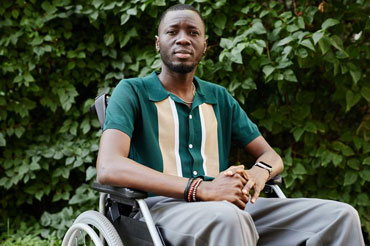
The council issued my blue badge, which allows me to park closer to shops, medical facilities, and other public places. They also support community transport services, which provide accessible transport for people with mobility issues.
I live in an accessible home, which was adapted with help from the council’s Disabled Facilities Grant (DFG). They helped fund my ramp, wider doorways, and a stairlift, making my home safer and easier to navigate.
Taking the bins out can be difficult, so I signed up for assisted bin collections. The council’s team collects my waste and recycling directly from my doorstep, making this everyday task much more manageable.
Many of Bracknell Forest’s parks, pathways, and public spaces are designed to be accessible. The council’s adult social care services provide carers and personal support for people with disabilities. They also run wellbeing programmes and disability support groups that help me stay connected with the community. Thanks to these council services, I can live independently, stay active, and remain part of the community.
Carly 44 and Sara 47
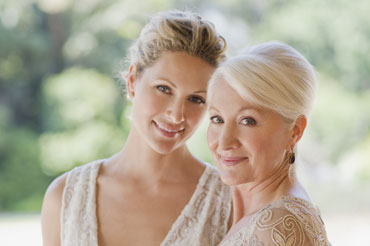
After 20 years of being together, Carly finally popped the question last year and we said I do in April! We knew there’d be lots to organise, and it would be a stressful (as well as happy) time, so we were grateful for the advice and guidance of the council’s registrars.
From giving our notice to marrying us at the registry office in South Hill Park, the whole thing was easy and professional. We’re expecting a little girl in March, so we’ll be using the team to register our daughter’s birth, and we are also thinking of planning a naming ceremony through them.
Lisa, 56, and Cameron, 58 - children have left home
We’ve benefitted a lot from council services over the years, especially when the children were at home - we used the education, library, early years, leisure and countryside services regularly.
Climate change is also important to us - we want to make sure our children have a better world to live their adult lives in. We make good use of the food waste and blue bin recycling schemes and regularly use the local electric vehicle charging points installed by the council. If we have any extra recycling or garden waste, we book a slot at the Longshot Lane waste and recycling centre - it’s simple and hassle free and there are always plenty of slots.
Margaret, 83 - retired
My older person’s bus pass is a lifeline, and it was so easy to apply for through the council’s website. I can use it to travel for free to the shops, doctors and to see friends.
As I live alone, I get a reduction in my Council Tax, easing the pressure of the cost of living. I love reading and the library service has been great at providing me with large print and audio books. I’ve also joined a scrabble group and craft group at my local library for free, which has helped keep my mind active as well as make new friends.
I’m not as steady as I used to be and so I needed a few adaptations to my home like grabrails - the council’s social care team sorted this out for me, so I can continue to live in my own home safely and independently.