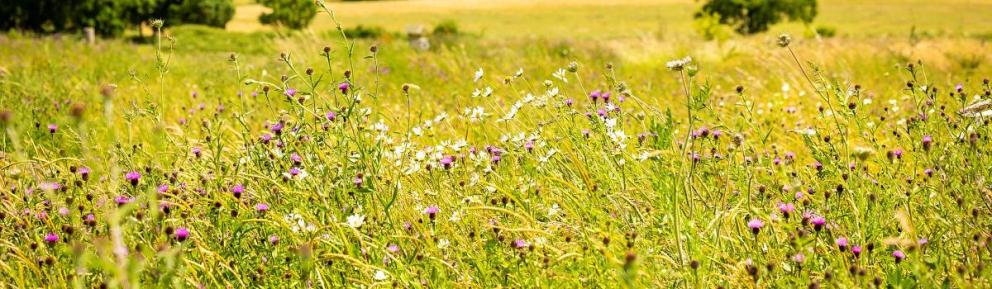
Bracknell Forest has a high cover of trees and woodlands alongside other habitats such as:
- grasslands
- heaths
- rivers
- ponds
These habitats provide a home for a wide range of wildlife.
This section draws on annual reports from the Thames Valley Environmental Records Centre (TVERC) and data collected directly from Council-managed sites. In the future, we plan to include information from a wider range of partners.
See the location of protected sites across the borough and other biodiversity information on the Biodiversity and Green Infrastructure interactive map.
Borough-wide summary
Nationally protected sites
Special Protection Areas (SPA), Special Areas for Conservation (SAC) and Sites of Special Scientific Interest (SSSI) are nationally important sites for nature. These sites may be managed by the council, other organisations or private landowners.
Part of the Thames Basin Heaths SPA lies within the borough, providing vital habitat for rare heathland birds such as the woodlark, nightjar, and Dartford warbler.
The borough also includes part of Windsor Forest and Great Park SAC, important for its ancient woodland and veteran oak trees.
There are 9 SSSIs wholly or partly within Bracknell Forest (split into 36 SSSI units), covering around 18% of the land area. Natural England monitors these sites every 5 to 6 years. No SSSIs were surveyed in Bracknell Forest in 2024 to 2025.
Condition of SSSI units by area

| Condition | Percentage of SSSI units |
|---|---|
| Favourable | 79.1% |
| Unfavourable but recovering | 20.4% |
| Unfavourable, no change | 0.5% |
| Unfavourable and declining | 0% |
These figures have remained stable in recent years.1
- 1
Biodiversity Annual Monitoring Report 2024 to 2025 (TVERC) - available from our monitoring page
Suitable Alternative Natural Greenspaces
To reduce the impact of new housing on the Thames Basin Heaths SPA, Bracknell Forest Council uses developer contributions to fund Suitable Alternative Natural Greenspaces (SANGs).
These green spaces provide attractive alternatives for recreation. This helps protect sensitive habitats and species.
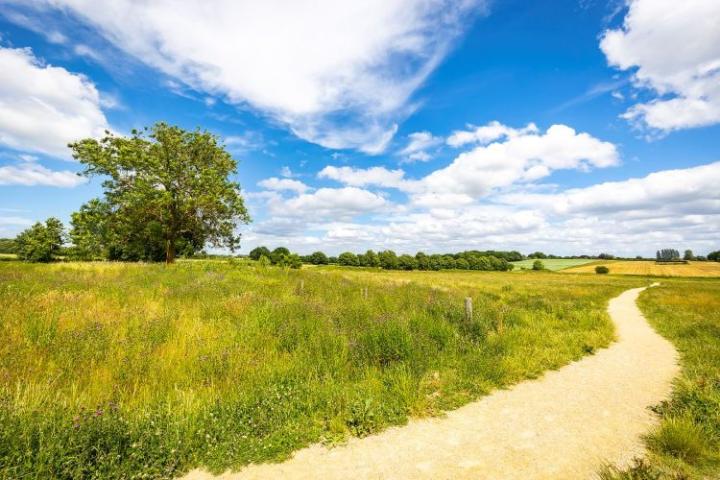
Photo of Frost Folly Park by Stewart Turkington.
Local Nature Reserves
Local Nature Reserves are designated by local authorities as important sites for:
- wildlife
- geology
- education
- enjoyment
Bracknell Forest has 10 designated Local Nature Reserves. They are all owned by the council and in active management.
Local Wildlife Sites and Local Geological Sites
These sites are selected by a regional panel for supporting important habitats, species and geology.
There are 4 Local Geological Sites (LGS) and 53 Local Wildlife Sites (LWS) in Bracknell Forest.2 Buttersteep Forest was designated as a large new Local Wildlife Site in 2024 TO 2025.
TVERC calculates the number of LWS and LGS that are in positive conservation management over a five-year period. The figure for Bracknell Forest for 2024 T0 25 was 63%, an increase of 1% from the previous year. The overall figure for Berkshire was 57%.3
- 2
Biodiversity Annual Monitoring Report 2024 to 2025 (TVERC) - available from our monitoring page
- 3
Single Data List 160 Improved Local Biodiversity in Berkshire (TVERC, 17 October 2025)
| LWS or LGS | 2023 to 2024 | 2024 to 2025 |
|---|---|---|
| Number of LWS | 52 | 53 |
| Number of LGS | 4 | 4 |
| Area of LWS (ha) | 394.97 | 659.98 |
| Area of LGS (ha) | 21.55 | 21.55 |
| LWS and LGS in positive conservation management | 62% | 63% |
Priority habitats
Priority habitats are habitats considered the most important for biodiversity conservation in England. They are listed under Section 41 of the Natural Environment and Rural Communities (NERC) Act 2006.
TVERC data shows that in 2025, Bracknell Forest had 1,310.52 hectares of priority habitat.4
Bracknell’s priority habitats include:
- lowland mixed deciduous woodland – 800.84ha
- lowland heathland – 185.16ha
- lowland meadows – 26.14ha
- lowland wood pasture and parkland – 78.52ha
- traditional orchards – 10.2ha
- wet woodland – 22.86ha
Priority species
Priority species are species identified under Section 41 of the NERC Act 2006. TVERC tracks species recorded in Bracknell Forest over 10-year periods.5
- 4
Biodiversity Annual Monitoring Report 2024 to 2025 (TVERC) - available from our monitoring page
- 5
Biodiversity Annual Monitoring Report 2024 to 2025 (TVERC) - available from our monitoring page
Number of priority species

| 10-year period | Number of priority species |
|---|---|
| 2008 to 2018 | 68 |
| 2009 to 2019 | 78 |
| 2010 to 2020 | 80 |
| 2011 to 2021 | 79 |
| 2012 to 2022 | 93 |
| 2013 to 2023 | 122 |
| 2014 to 2024 | 125 |
| 2015 to 2025 | 123 |
Species are removed from the list if there are no new records within the last 10 years. This does not necessarily mean they are gone, just that they have not been recorded recently. Similarly, new additions may reflect older sightings only recently shared with TVERC.
Wildlife monitoring
Bracknell Forest Council’s Parks and Countryside teams work with volunteers to carry out wildlife surveys across our sites each year. These surveys act as a biodiversity health check, helping us understand how wildlife is doing across the borough.
We have monitored some species over many years, giving us valuable long-term data.
Reptiles
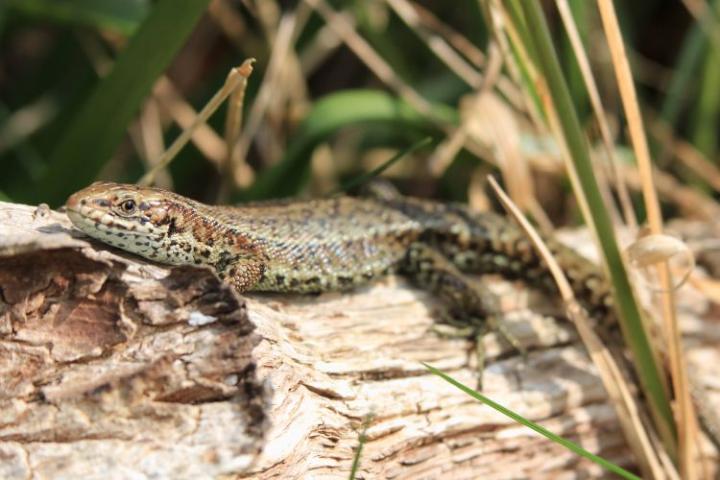
There are 6 reptiles native to the UK, 4 of these are found within Bracknell Forest. These are:
- common lizard
- slow worm
- grass snake
- adder
They are all on the national list of priority species. Research in 2019 showed 90% of Adder populations nationally are in decline.6
Photo of a common lizard by Rob Solomon.
Monthly surveys of council-owned heathland sites help us understand reptile populations and distribution. This guides site management. Surveys take place across four heathland sites. These are:
- Caesar’s Camp
- Wildmoor Heath
- Buckler’s Forest
- Englemere Pond
Buckler’s Forest is a designated Local Wildlife Site, partly due to its reptile populations. Reptile populations and distribution are doing well at Englemere and Caesar’s Camp. Wildmoor had previously been showing signs of increased scrub and other overgrowth, but is thought to have improved over the last 2 years.
The graph and tables below show recent results from these 4 sites.
2024 and 2025 reptile records

Caesar's Camp reptile records
| Year | Adder | Grass snake | Slow worm | Common lizard |
|---|---|---|---|---|
| 2024 | 21 | 17 | 20 | 13 |
| 2025 | 4 | 9 | 19 | 6 |
Wildmoor Heath reptile records
| Year | Adder | Grass snake | Slow worm | Common lizard |
|---|---|---|---|---|
| 2024 | 0 | 1 | 53 | 4 |
| 2025 | 7 | 0 | 42 | 6 |
Buckler’s Forest reptile records
| Year | Adder | Grass snake | Slow worm | Common lizard |
|---|---|---|---|---|
| 2024 | 1 | 4 | 66 | 6 |
| 2025 | 0 | 3 | 27 | 3 |
Englemere Pond reptile records
| Year | Adder | Grass snake | Slow worm | Common lizard |
|---|---|---|---|---|
| 2024 | 3 | 8 | 21 | 3 |
| 2025 | 8 | 13 | 22 | 3 |
Appendix 1 shows the long-term annual results.
Newts
There are 3 native species of newt and all can be found in Bracknell Forest. They are:
- the great crested newt, which is present in a range of ponds
- the smooth newt, which prefers water with a neutral pH
- the palmate newt, which prefers more acidic, heathland ponds
Our most famous newt, the great crested newt, is a European protected species. Bracknell Forest Council and Warfield Environment Group have been monitoring great crested newts at The Newt Reserve in Warfield for over 20 years.
The graph below shows recent results of Bracknell Forest Council surveys (2 surveys per year) for The Newt Reserve (front pond).
2024 and 2025 new records at The Newt Reserve

| Year | Number of great crested newts | Number of smooth newts |
|---|---|---|
| 2024 | 5 | 10 |
| 2025 | 5 | 56 |
Appendix 1 shows long-term results from The Newt Reserve. Numbers can vary due to weather conditions and survey effort.
Butterflies
Butterflies are valuable environmental indicators. This is because we can learn from:
- their short life cycles
- their preference for specific plants (especially when they are caterpillars)
- how they respond to weather
Butterflies can tell us a lot about site management and the effects of a changing climate.
Photo of gatekeeper butterfly by Rob Solomon.
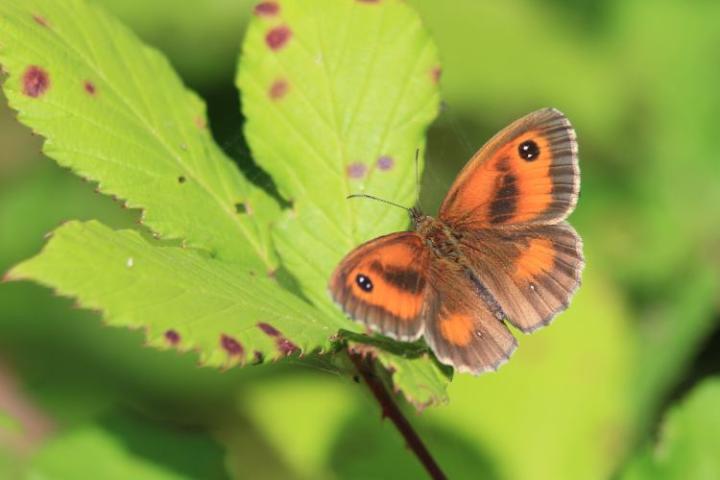
UK trends show 80% of butterfly species have decreased in abundance or distribution, or both, since the 1970s.7
We currently survey 3 sites regularly. These are:
- Buckler’s Forest
- Frost Folly
- Big Wood & Peacock Meadows North
The graph and tables below show recent results for these sites. Appendix 1 shows longer-term results.
- 7
The State of the UK's Butterflies 2022 Report (Butterfly Conservation)
2024 and 2025 number of butterfly species recorded

2024 and 2025 number of butterfly individuals recorded

Buckler's Forest butterfly records
| Year | Total species | Total individuals |
|---|---|---|
| 2024 | 25 | 1,459 |
| 2025 | 25 | 1,629 |
Frost Folly butterfly records
| Year | Total species | Total individuals |
|---|---|---|
| 2024 | 20 | 507 |
| 2025 | 14 | 622 |
Big Wood and Peacock North butterfly records
| Year | Total species | Total individuals |
|---|---|---|
| 2024 | 22 | 691 |
| 2025 | 22 | 521 |
Grayling butterflies are declining in many inland areas.8 Buckler’s Forest is an important site, with 73 individuals recorded in 2024 and 106 recorded in 2025.
Brown hairstreak butterflies are priority species identified under Section 41 of the NERC Act 2006. They have a limited distribution in the south of the UK only and are in decline in Britain due to hedgerow removal and cutting.9
An adult brown hairstreak butterfly was sighted at Shepherd Meadows in the summer of 2025. Following this sighting, an egg count survey was undertaken in December 2025 with the help of volunteers, which found 35 brown hairstreak eggs. An additional individual brown hairstreak egg was then found near Ascot.
- 8
The Grayling butterfly (Butterfly Conservation)
- 9
Brown Hairstreak butterfly (Butterfly Conservation)
Breeding bird surveys
Bird populations are often used as a good indicator of the overall health of wildlife in the UK. This is because birds live in many different habitats and respond to the same environmental pressures that affect other species.10
Nationally, farmland bird populations have declined by 62% since 1970, though the rate of decline has reduced in more recent years.11 During spring, we monitor several sites using a set breeding bird survey. Records inform our ongoing site management.
The graph and table below show the average number of bird species recorded across transects at Frost Folly and Buckler’s Forest in 2024 and 2025.
- 10
Birds of the wider countryside and at sea (Joint Nature Conservation Committee, 2 December 2025)
- 11
Birds of the wider countryside and at sea (Joint Nature Conservation Committee, 2 December 2025)
2024 and 2025 average number of bird species recorded

| Year | Frost Folly | Buckler's Forest |
|---|---|---|
| 2024 | 13.62 | 12.99 |
| 2025 | 17.75 | 10.88 |
Heathland Birds
We undertake heathland bird surveys at Wildmoor Heath. These surveys form part of a wider Thames Basin Heaths monitoring program. Walks are undertaken during the day and at night over the summer months. The site is split into zones and bird territories are identified in each zone.
2024 and 2025 SPA bird territories at Wildmoor Heath

| Year | Dartford Warbler | Nightjar | Woodlark |
|---|---|---|---|
| 2024 | 5 | 5 | 0 |
| 2025 | 4 | 4 | 1 |
Small mammals
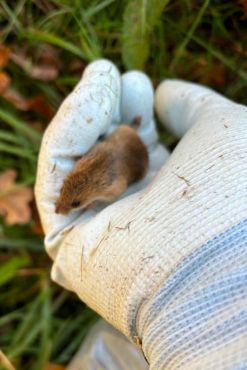
Many mammal species are in decline, with more than a quarter of UK mammal species facing local extinction.12
The harvest mouse is an iconic British species and is one of the Bracknell Forest Biodiversity Action Plan species. With help from volunteers, we search for harvest mouse nests at some of our sites. At Shepherd’s Meadows, 36 nests were found in 2024, and 37 in 2025. Appendix 1 shows longer-term results.
- 12
Why mammals matter (The Mammal Society)