Waste disposal savings
By recycling correctly residents could help save the council over £1 million in waste disposal costs.
75% of the waste collected from the green general waste bins could be recycled.
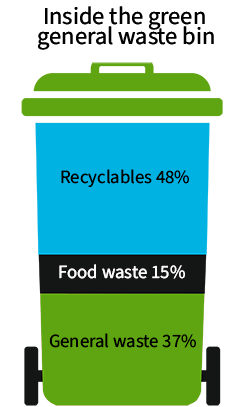
Almost 5,000 tonnes of food waste is still being put in green general waste bins. If this food waste was recycled correctly in the black food waste caddies or communal bins, we would save more than £500,000 in disposal costs.
Recycling all paper, card, plastic bottles, pots, tubs and trays, tins, cans, aerosols, foil and cartons in the blue recycling bin could save £220,000.
Recycling textiles and glass at local recycling sites could save £270,000. Residents can also donate unwanted household items straight from their doorstep.
Using the recycling centre at Longshot Lane or the garden waste collection service could save a further £40,000.
Missed bin collections
The table below shows the percentage of missed bin collections over the last 5 years.
| Financial year | Bin type included | % of bins missed per year |
|---|---|---|
| 2024 to 2025 | General (green), recycling (blue) and garden (brown) | 0.04% |
| 2024 to 2025 | Food | 0.04% |
| 2023 to 2024 | General (green), recycling (blue) and garden (brown) | 0.04% |
| 2023 to 2024 | Food | 0.04% |
| 2022 to 2023 | General (green), recycling (blue) and garden (brown) | 0.04% |
| 2022 to 2023 | Food | 0.06% |
| 2021 to 2022 | General (green), recycling (blue) and garden (brown) | 0.04% |
| 2021 to 2022 | Food | 0.11% |
| 2020 to 2021 | General (green), recycling (blue) and garden (brown) | 0.05% |
Recycling and landfill rates
The table below shows the recycling and landfill rates over the last 5 years.
| Financial year | Recycling rate | Landfill rate |
|---|---|---|
| 2023 to 2024 | 56% | 8% |
| 2022 to 2023 | 55% | 8% |
| 2021 to 2022 | 56% | 7% |
| 2020 to 2021 | 43% | 16% |
| 2019 to 2020 | 43% | 17% |